Snakes
of Morocco
The 26 snake species currently recognised for Morocco are presented in this guide through their diagnostic characters, ecology, distribution, and the principal conservation issues associated with them.
A fauna between Mediterranean mountains and the Sahara
LMorocco's snake fauna reflects an exceptional meeting point between Mediterranean, Atlantic, montane, Saharan and Afro-tropical influences.
Some snakes are widespread across farmland and rocky landscapes, while others depend on narrow ecological conditions: high mountain slopes, permanent freshwater, Atlantic coastal steppe, isolated oases or mobile sand dunes.
Forests, matorral, rocky slopes, agricultural land, and settlement margins support numerous colubrids as well as the Moorish viper.
Cool valleys and high slopes support localised species such as the Lataste's viper complex and the Iberian grass snake.
Dry plateaus and vegetated wadis form ecological transitions between Mediterranean and Saharan assemblages.
Specialists include horned vipers, sand vipers, the Moila snake, and rare Afro-tropical relicts.
Eight families, distinct ecological strategies
Organisation at family level facilitates navigation through the guide, while functional risk categories are kept distinct from taxonomy.
Leptotyphlopidae
Threadsnakes
Fossorial specialisation is observed in very small species associated with dry environments containing locally more humid microhabitats.
1 speciesBoidae (Erycidae)
Sand boas
A rare, non-venomous constrictor is represented in Morocco by a single species.
1 speciesColubridae
Colubrids
The highest species diversity in the guide is represented within this family, which includes both fast-moving forms and desert specialists.
10 speciesNatricidae
Water and grass snakes
Two semi-aquatic, non-venomous species are associated with freshwater habitats.
2 speciesLamprophiidae
African house snakes
An Afro-tropical lineage is represented in Morocco by a rare relict population in the south-west.
1 speciesPsammophiidae
Sand racers
Four active rear-fanged predators are represented, including both Montpellier snakes.
4 speciesElapidae
Cobras
A single front-fanged species of medical importance is represented in Morocco: the Moroccan black cobra.
1 speciesViperidae
Vipers
Six viper species of medical importance are represented in montane, steppe, and Saharan habitats.
6 speciesIdentification should be based on character combinations — never on a single trait
Dorsal pattern, pupil morphology, head shape, and scale arrangement may show substantial variation or morphological convergence. Reliable identification should therefore be based on a combination of characters, supported by habitat, locality, and high-quality photographs.
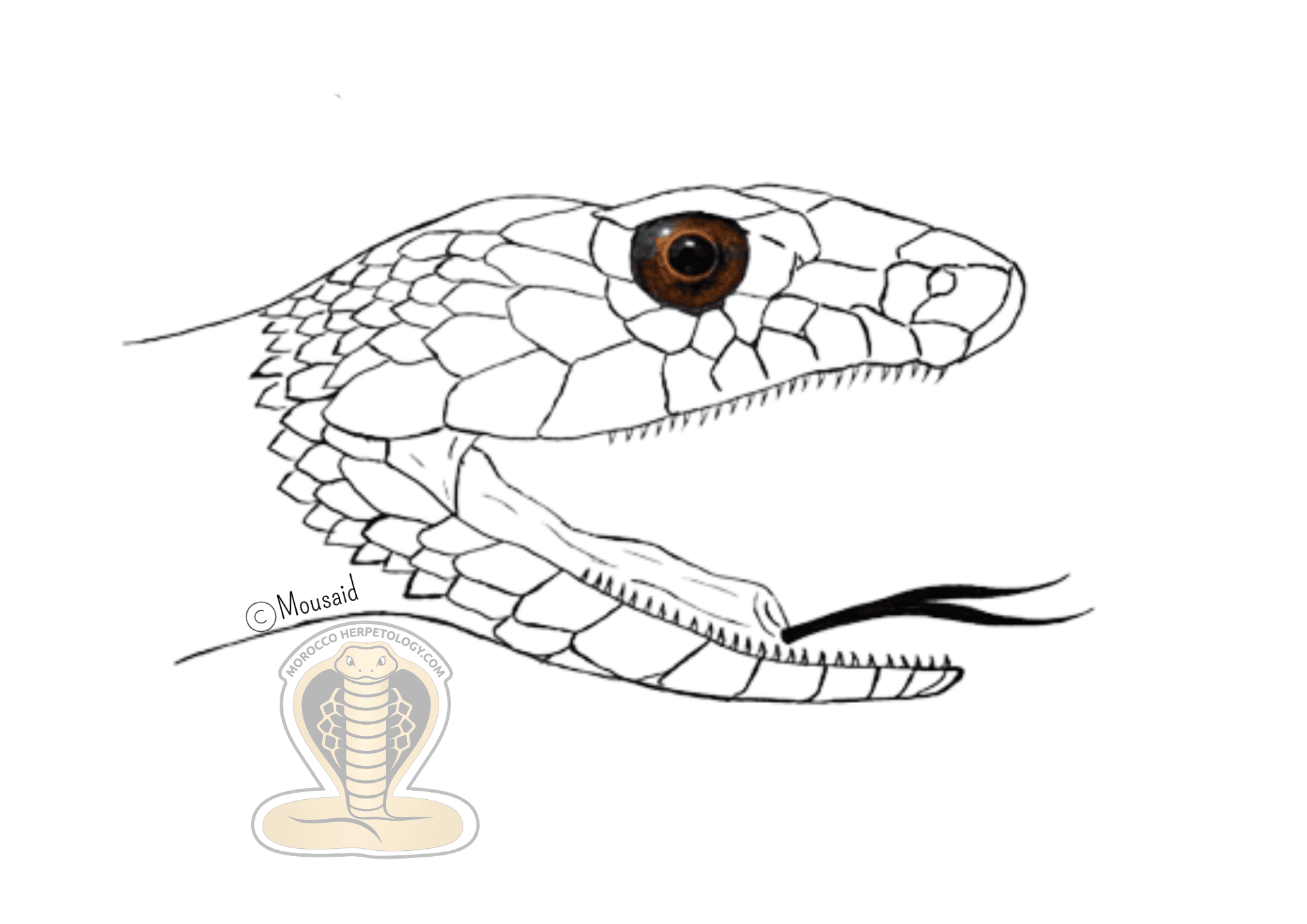
Non-venomous
Includes threadsnakes, the sand boa, many colubrids and both Moroccan Natrix. Some harmless species can imitate vipers when threatened
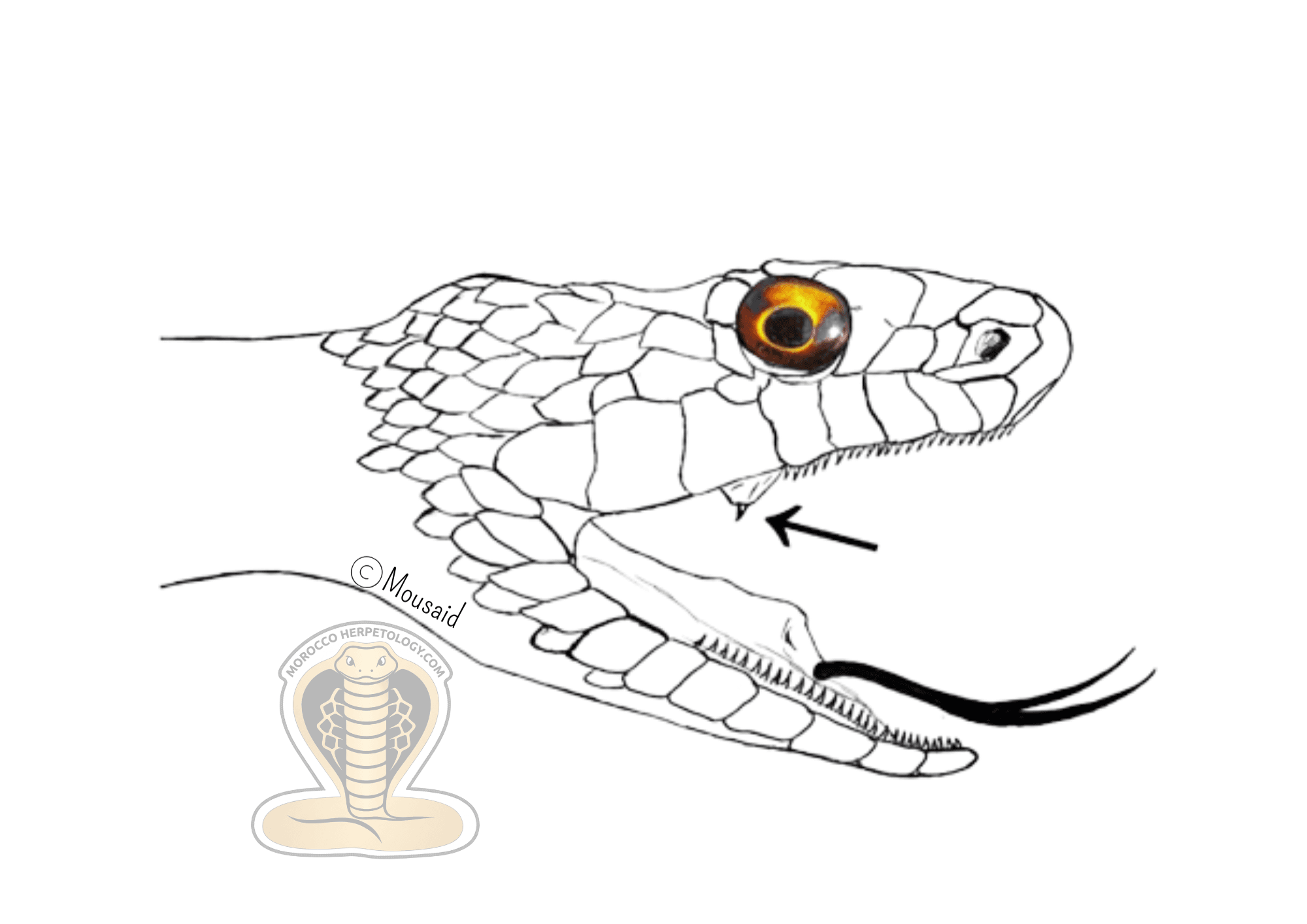
Rear-fanged
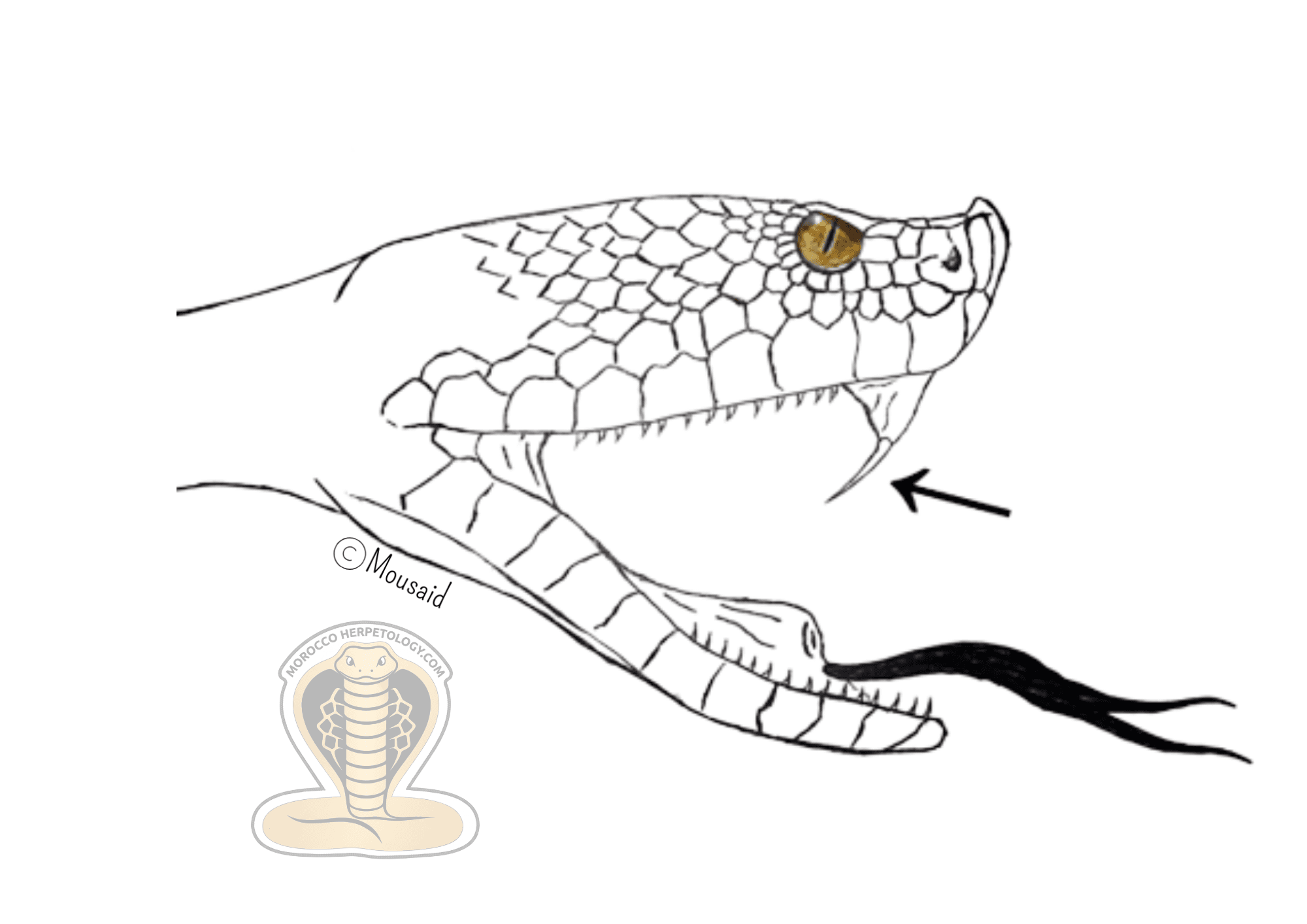
In rear-fanged species, specialised teeth are positioned toward the posterior part of the upper jaw. Most Moroccan species in this group are considered of low medical importance; however, envenomation may occur following prolonged bites by large Montpellier snakes or during handling.
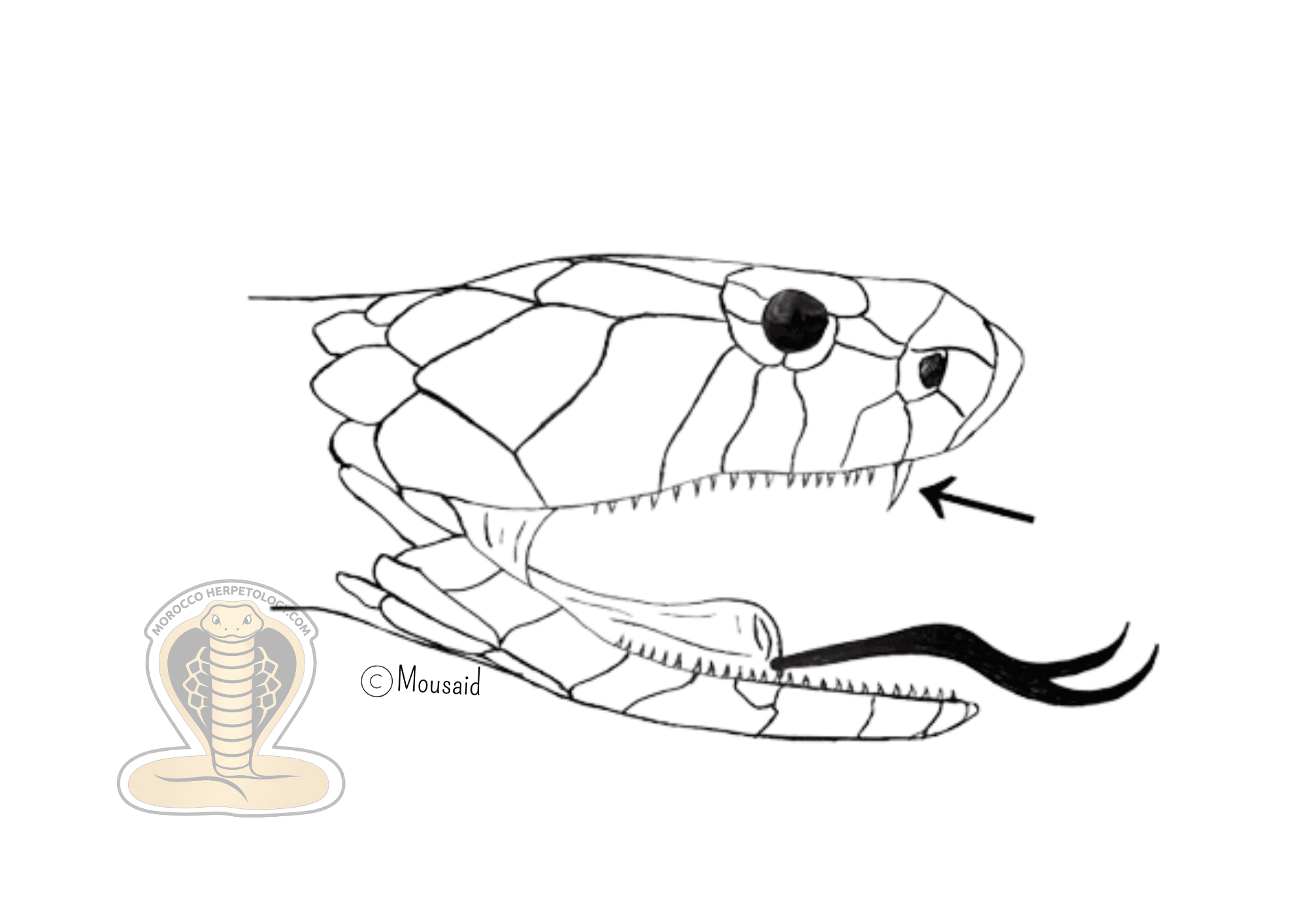
Medically important
One cobra and six vipers of medical importance are currently recognised in Morocco. Approaching, handling, pinning, or attempting to kill a potentially venomous snake should be avoided.
Head scales
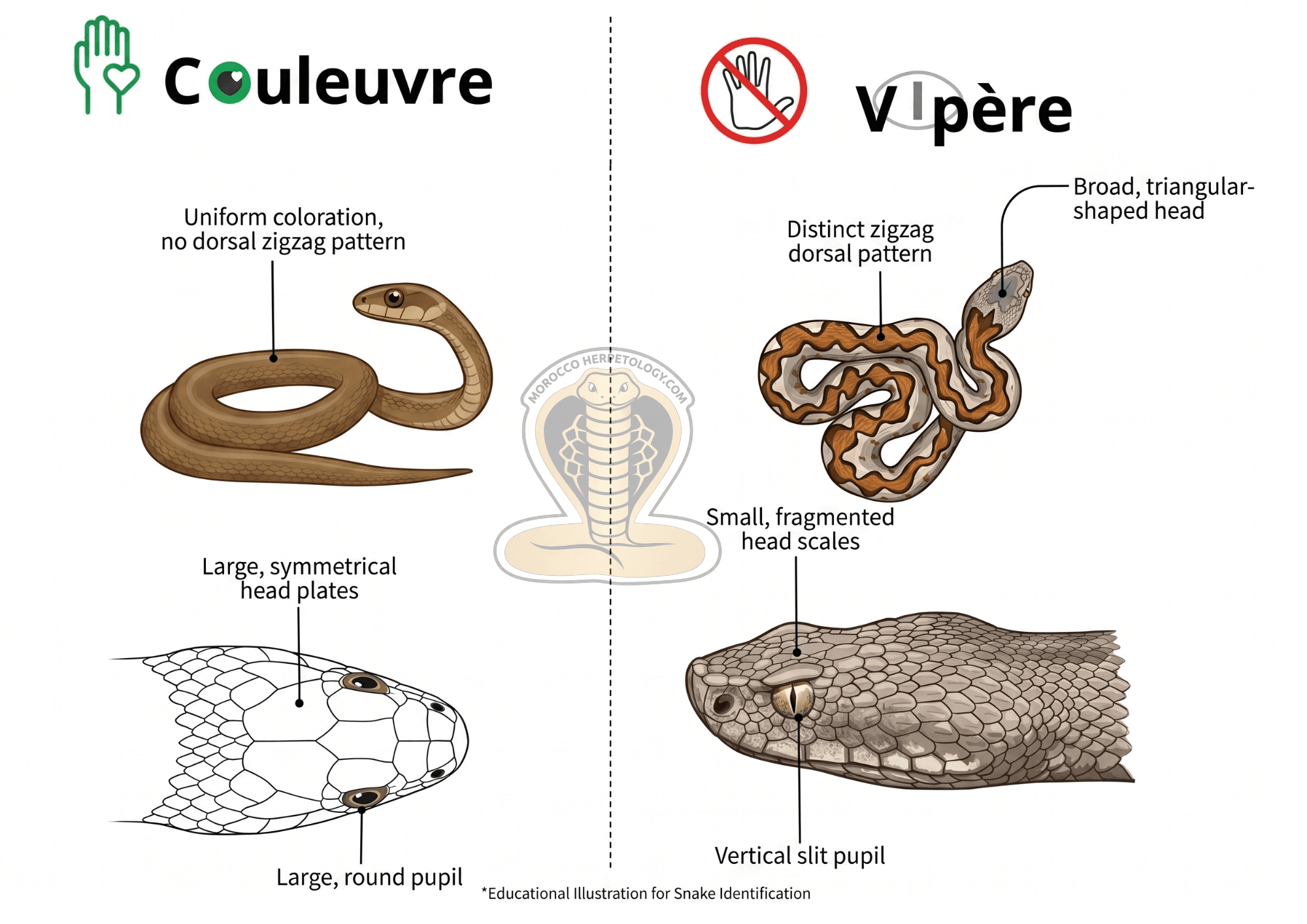
Large symmetrical head plates are observed in many harmless colubrids, whereas smaller and generally rougher head scales occur in several vipers. This character should not be used in isolation, as exceptions are known.
Body form & scales
Overall body form, scale texture, flank-scale orientation, and tail proportions should be assessed jointly. A triangular head alone is not a reliable diagnostic character, as this shape may be produced by defensive flattening in some harmless species.
Dorsal pattern
Un zigzag dorsal ne prouve pas qu’un serpent est venimeux : Natrix maura présente souvent ce motif, et plusieurs espèces inoffensives peuvent imiter des serpents dangereux.
Locality & habitat
Markedly different ecological requirements are observed among dune specialists, montane vipers, and aquatic snakes. Geographic and ecological context should therefore be incorporated into any proposed identification.
Important: This guide should be used for orientation only. A snake should not be approached or handled for identification. Photographs should be obtained from a safe distance using zoom, and expert confirmation should be sought whenever uncertainty remains.
In the event of a bite, movement should be minimised and medical care reached rapidly
Following a snakebite, the person should be moved away from the snake, reassured, and kept as still as possible. Rings and other constricting items should be removed early; the affected limb should be immobilised and, where possible, splinted, while rapid transfer to a health facility should be arranged.
WHO snakebite guidance →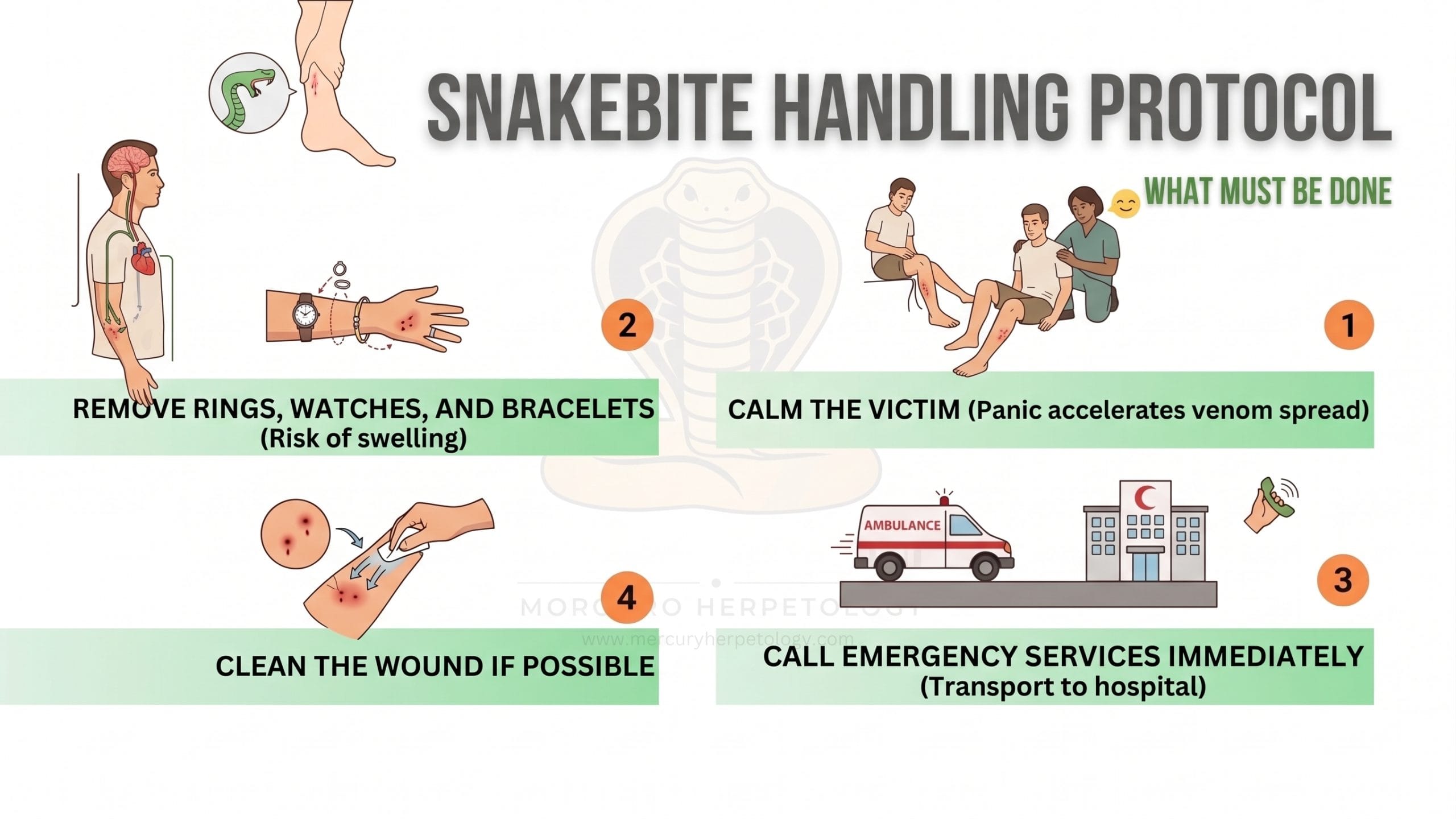
- The person should be reassured and kept as still as possible.
- Rings, watches, and tight clothing should be removed before swelling develops or increases.
- The bitten limb should be immobilised and, where possible, splinted to minimise movement.
- Walking should be avoided and rapid transport to a health facility should be arranged.
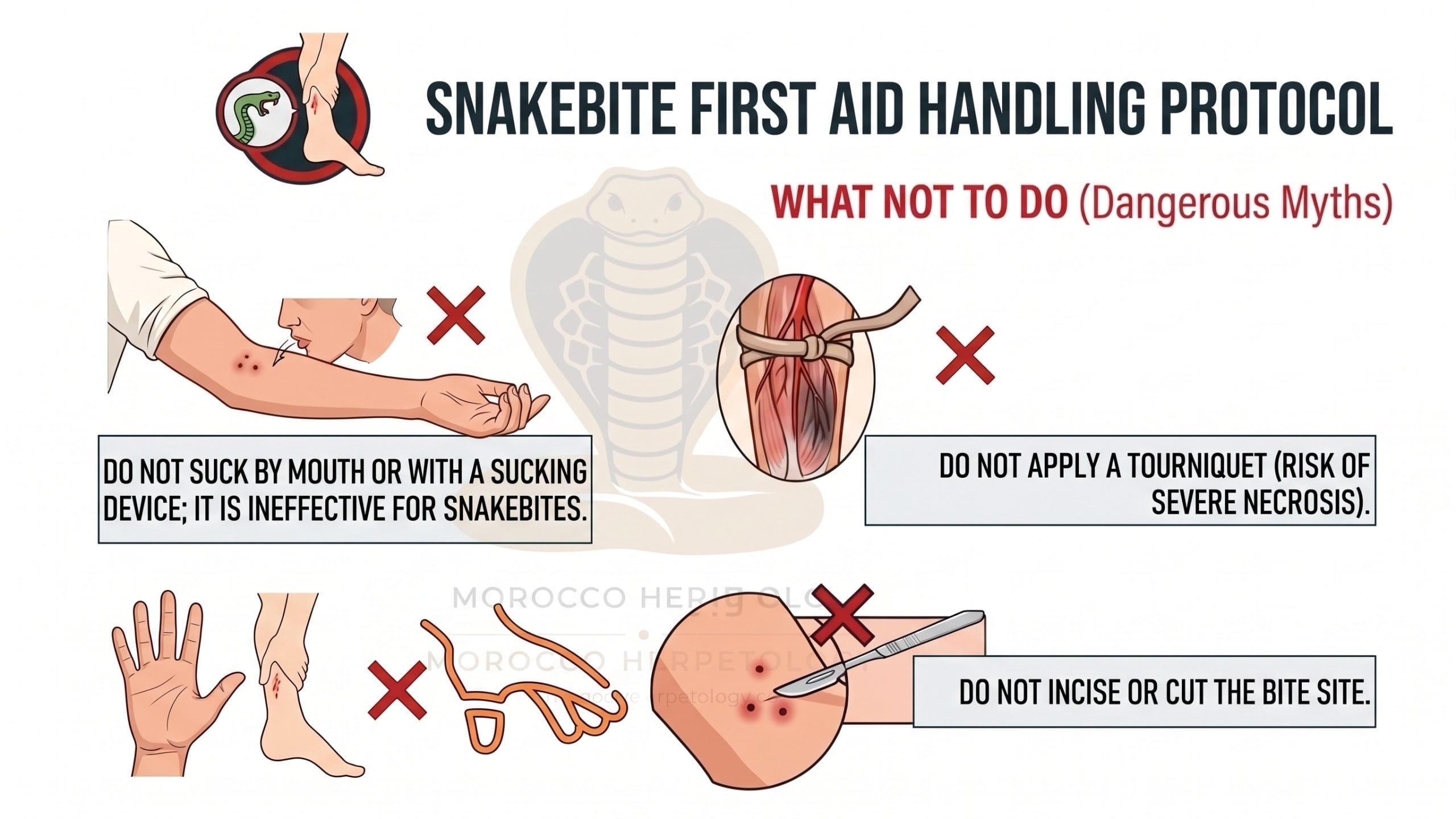
- A tight arterial tourniquet should not be applied.
- The bite site should not be cut, sucked, or cauterised.
- Unproven traditional or herbal remedies should not be used.
- The snake should not be approached, captured, or killed.
The 26 snakes of Morocco
The guide can be searched by scientific, English, French, or Arabic name, and filtered by taxonomic family or functional risk group.
Showing 26 of 26 species
Threadsnakes
1 species
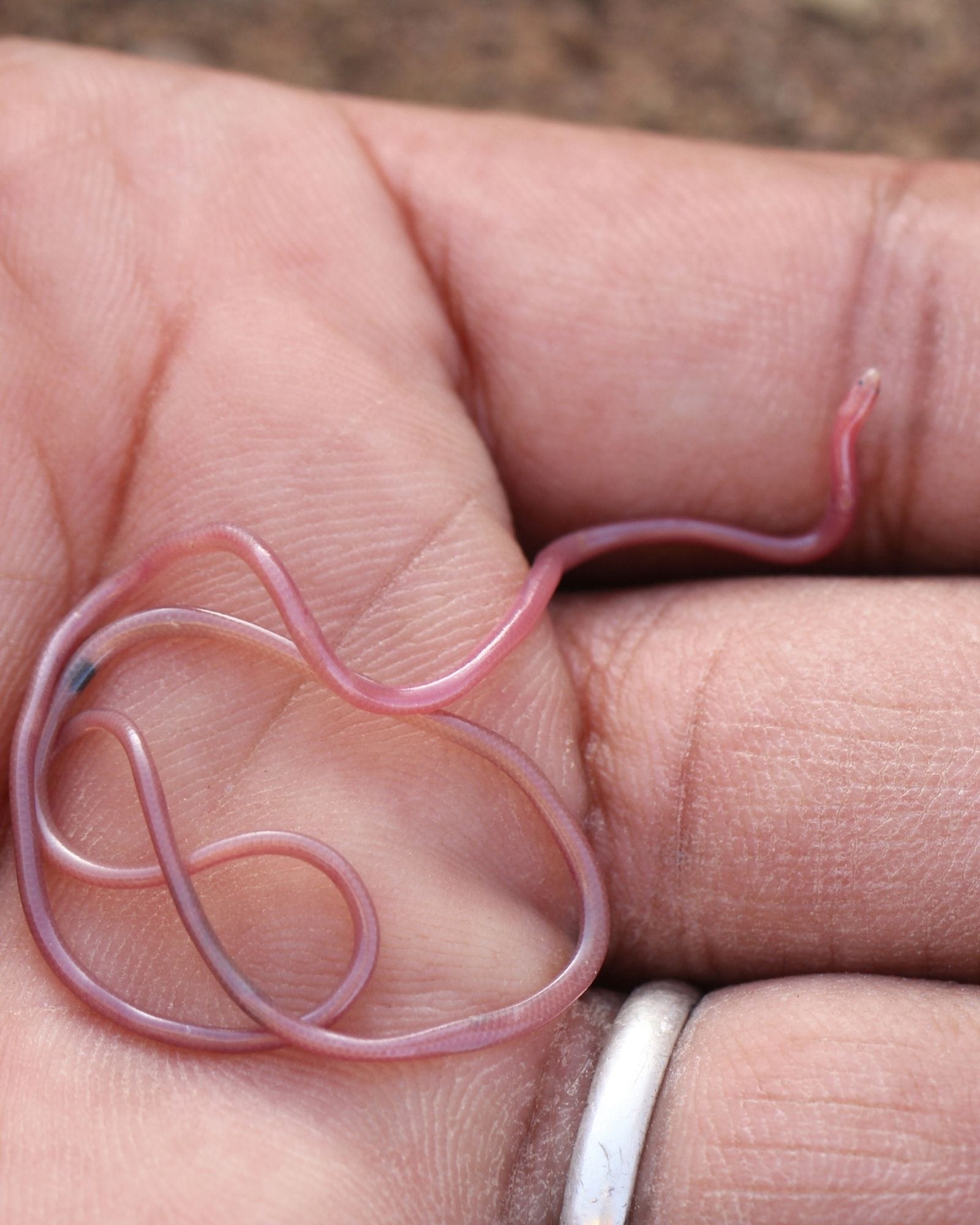
Algerian threadsnake
Myriopholis algeriensis (Jacquet, 1895)
FR · Leptotyphlops d'Algérie·الثعبان الخيطي
Key field characters
A minute, worm-like snake with smooth glossy scales, a brown to pale pink body, a hooked snout in side view, and a head barely distinct from the tail.
Habitat & natural history
Lives below stones and around roots in humid pockets of otherwise dry landscapes. It may surface after rain and is also recorded near palm groves and human settlements.
Distribution in Morocco
Recorded along Morocco's northern Saharan margins, including the Drâa and Ziz valleys and the Guelmim-Oued Noun region; additional occurrence is considered possible farther east and around Tan-Tan.
Project assessment
Although treated as Least Concern in the guide, populations are localized by their need for some soil moisture and may be affected by desertification.
Sand boas
1 species
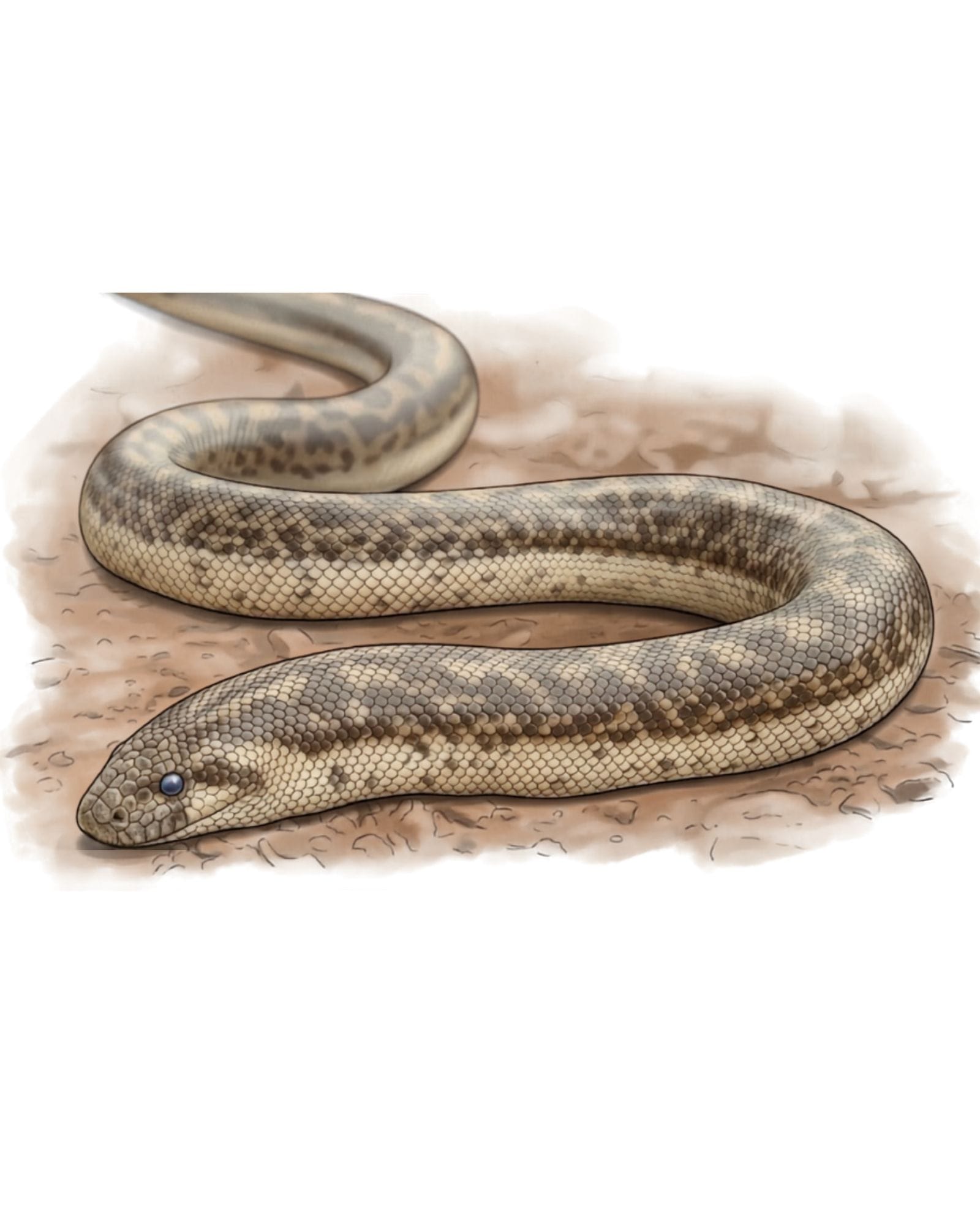
Javelin sand boa
Eryx jaculus (Linnaeus, 1758)
FR · Boa javelot·أصلة الرمال المرقطة
Key field characters
A short, robust snake with smooth shiny scales, a blunt head that is weakly differentiated from the body, small eyes and a vertical pupil.
Habitat & natural history
A burrowing constrictor associated with loose, sparsely vegetated soils. It spends much of its time below stones or inside small-mammal burrows.
Distribution in Morocco
In Morocco, the species is rare and restricted to the east, from the lower Moulouya region through Guercif toward northern Midelt, with records on the high plateaus around Tendrara.
Project assessment
The project guide considers the Moroccan population Data Deficient because the species is rare, secretive and apparently declining in the Mediterranean region.
Colubrids
10 species
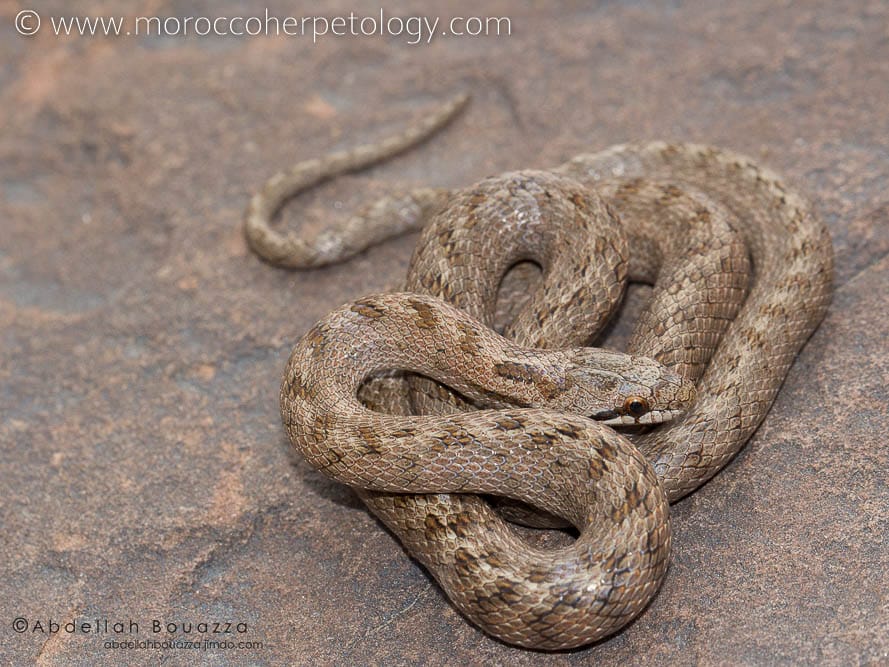
Southern smooth snake
Coronella girondica (Daudin, 1803)
FR · Coronelle girondine·حنش أمغر
Key field characters
A slender, smooth-scaled snake with a dark eye stripe reaching the snout, transverse dorsal markings and a contrasting black-and-yellow chequered belly.
Habitat & natural history
Associated with mountain forests, matorral, rocky valleys and cool high-elevation habitats. It spends long periods concealed beneath flat stones and constricts small reptile prey.
Distribution in Morocco
Known from the Rif, Middle Atlas and High Atlas up to about 2,900 m, as well as humid Mediterranean coastal sectors.
Project assessment
The species is listed as Least Concern in the guide, but its low detectability makes local population trends difficult to evaluate.
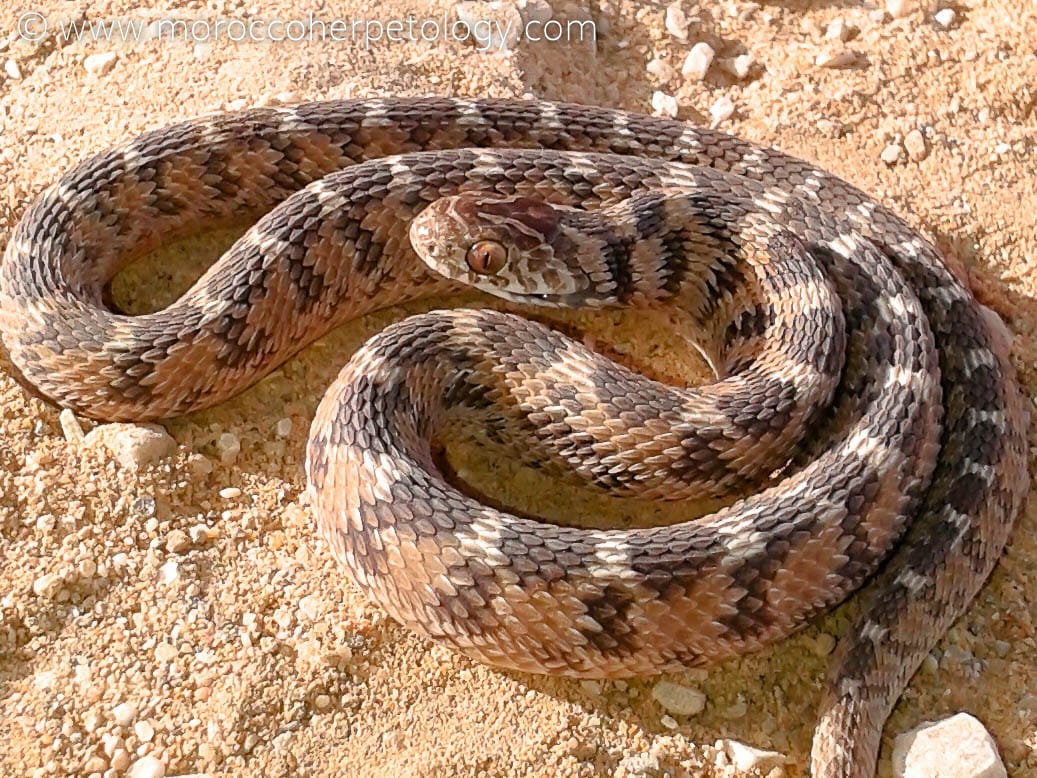
Sahel egg-eater
Dasypeltis sahelensis Trape & Mané, 2006
FR · Serpent mangeur d'œufs du Sahel·حنش آكل البيض
Key field characters
A small snake with a short rounded head, vertical pupils, strongly keeled dorsal scales and oblique serrated flank scales. When threatened it coils and rubs its flanks to produce a rasping sound.
Habitat & natural history
A specialized egg-eater whose activity follows the bird-nesting season, mainly from late winter into early summer. Its defensive display closely resembles that of Echis vipers.
Distribution in Morocco
A localized Sahelian relict in south-western Morocco, with an important population associated with argan and euphorbia landscapes around Sidi Ifni.
Project assessment
The guide considers it Vulnerable in Morocco because populations are rare and affected by road mortality, open wells and deliberate killing.
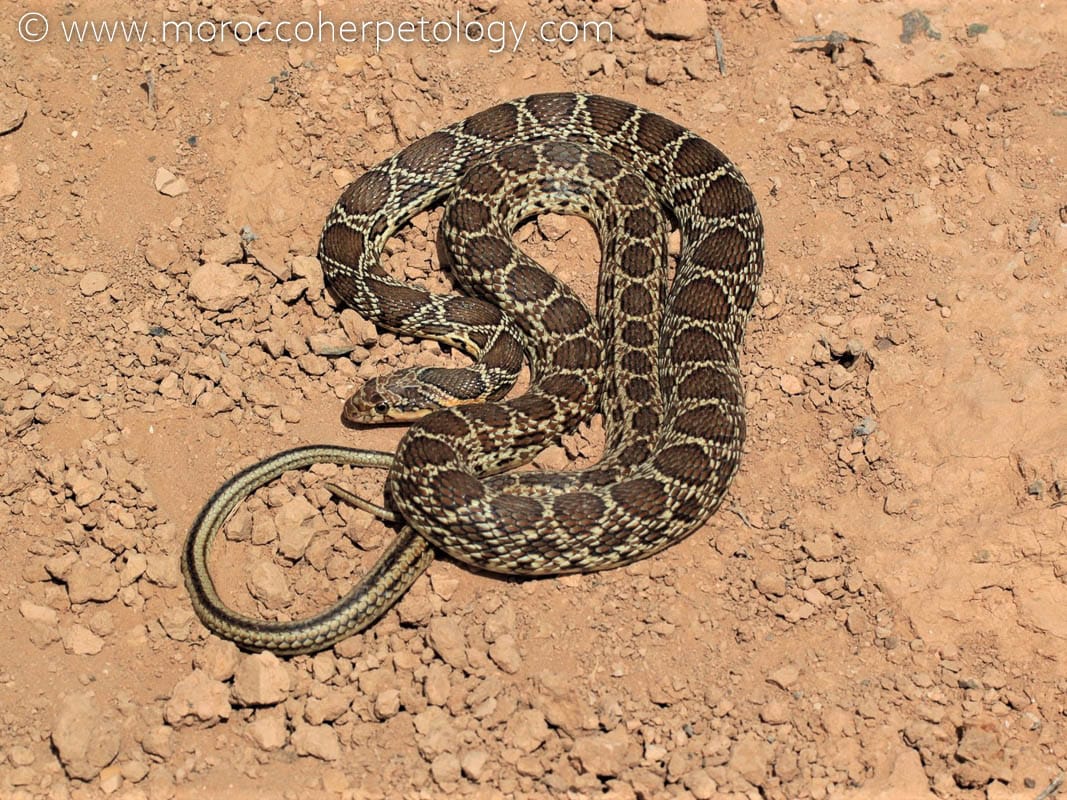
Horseshoe whip snake
Hemorrhois hippocrepis (Linnaeus, 1758)
FR · Couleuvre fer-à-cheval·حنش حدوة الحصان
Key field characters
A long, fast snake with large round-pupilled eyes, smooth glossy scales, a horseshoe-shaped mark behind the head and a row of bold dark dorsal blotches edged in pale colour.
Habitat & natural history
Uses rocky and shrubby habitats, farmland and the surroundings of buildings. It climbs walls and trees while searching for birds and nests.
Distribution in Morocco
Widespread through Mediterranean and Atlantic Morocco and south to the northern Anti-Atlas; much rarer in the Sahara.
Project assessment
Still widespread, but frequently killed near houses and collected for snake-charming displays. It can be confused with Daboia mauritanica at a distance.
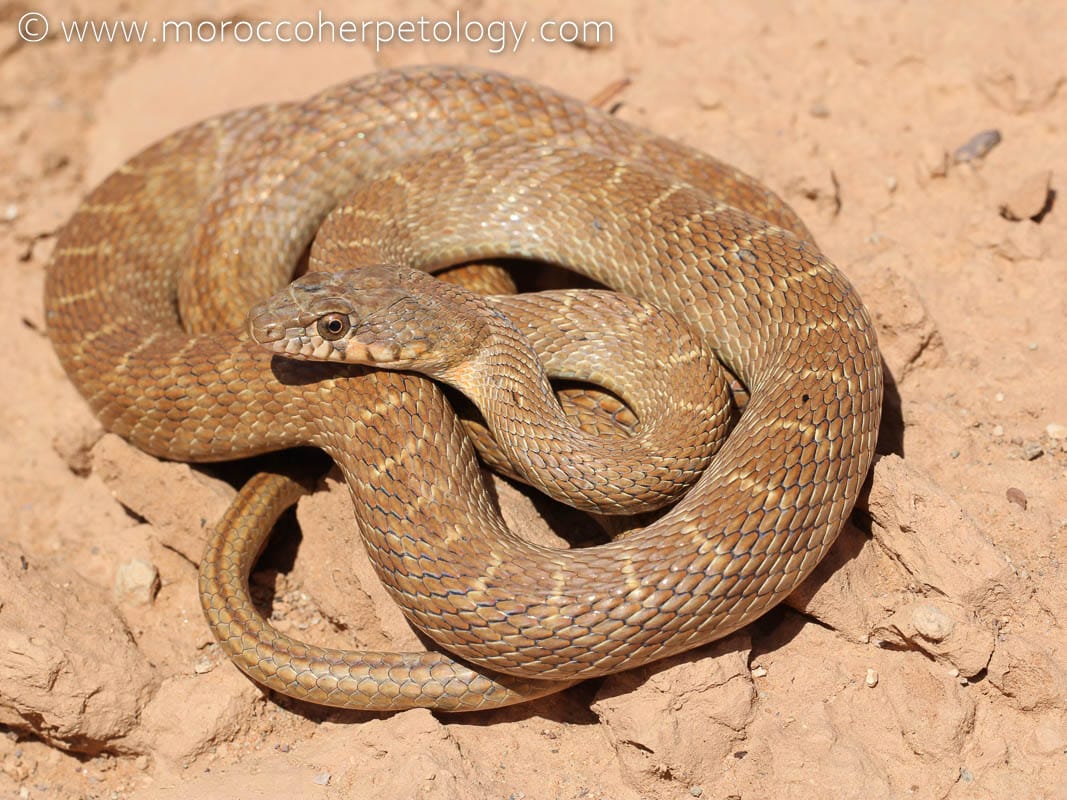
Algerian whip snake
Hemorrhois algirus (Jan, 1863)
FR · Couleuvre algire·حنش حدوة الحصان الجزائري
Key field characters
Generally duller and less contrasted than the horseshoe whip snake, with a narrower head; one or two upper lip scales contact the eye, and some populations have a uniformly dark head.
Habitat & natural history
Lives in rocky arid steppe with thorny shrubs and may enter gardens, old walls and oasis settlements. In extreme heat it emerges around dusk or early night.
Distribution in Morocco
Occurs across Morocco's Atlantic Sahara and along the Drâa and Ziz valleys to Figuig.
Project assessment
Treated as Least Concern at the North African scale in the guide, but its discreet behaviour leaves its Moroccan status insufficiently documented.
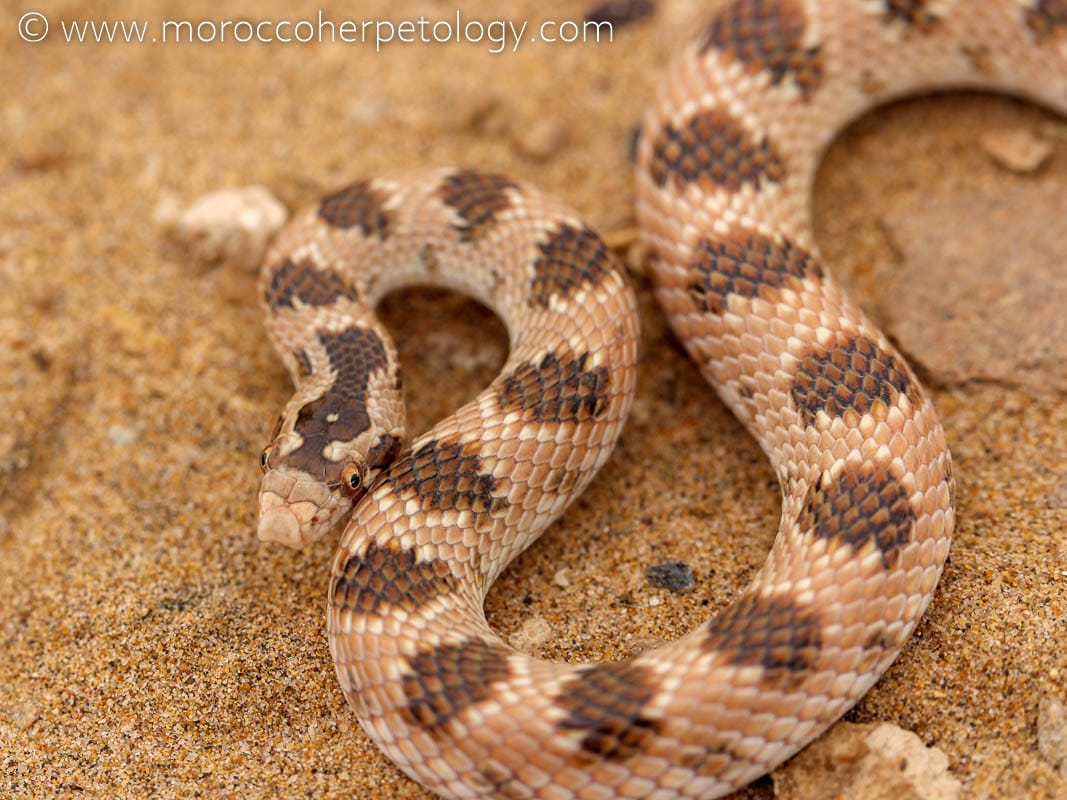
Awl-headed snake
Lytorhynchus diadema (Duméril, Bibron & Duméril, 1854)
FR · Couleuvre fouisseuse à diadème·حنش التاج الدفان
Key field characters
A small, slender snake with smooth scales, diamond-shaped dorsal blotches, a diadem-like head marking and a flattened, shovel-shaped rostral scale adapted for digging.
Habitat & natural history
A specialized burrower associated with sandy desert steppe and Saharan ergs. It travels over sand at night and hides below stones or beneath the surface by day.
Distribution in Morocco
In Morocco, the species is localised in desert steppe wherever suitable sand patches occur, sometimes living alongside Cerastes cerastes and Cerastes vipera.
Project assessment
Relatively rare but locally common in suitable habitat; the guide considers it Least Concern because many occupied sites are difficult to access.
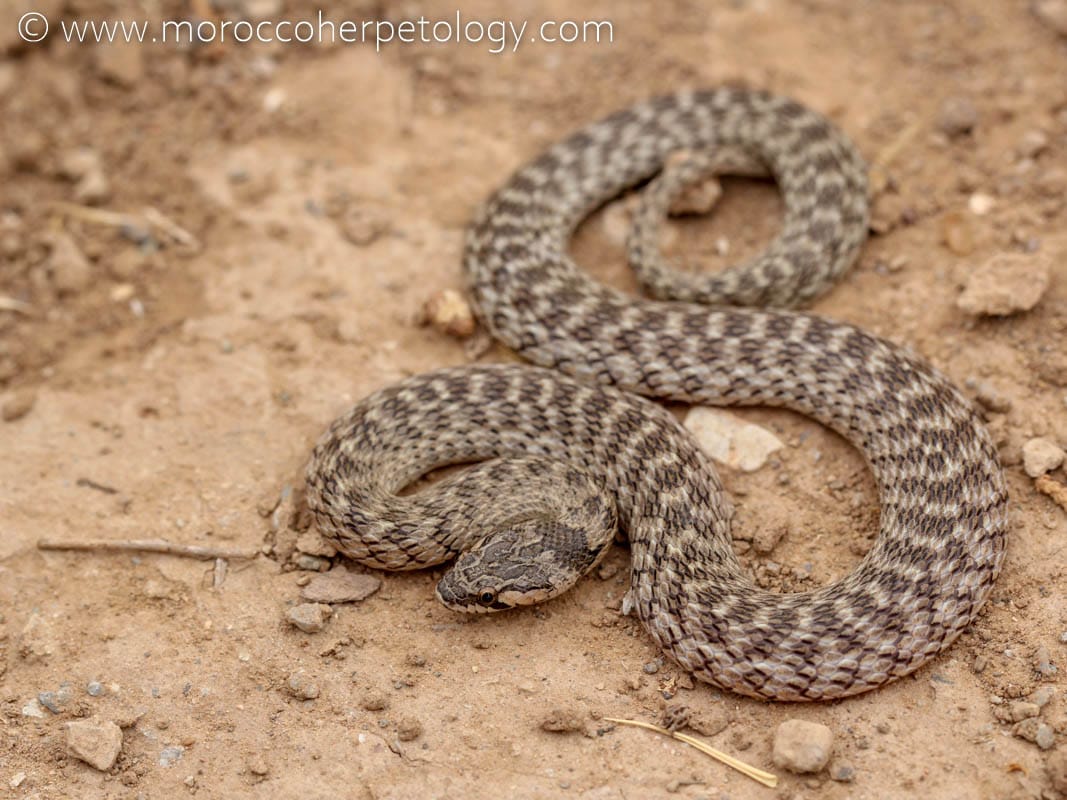
Western false smooth snake
Macroprotodon brevis (Günther, 1862)
FR · Couleuvre à capuchon occidentale·حنش ذو قبعة غربي
Key field characters
A small glossy snake with a flattened snout, a dark oblique stripe from the eye to the mouth and variable marbling. The collar and head pattern vary considerably.
Habitat & natural history
Occupies dry scrub, forest clearings, stone walls, farmland and arid steppe. It spends the day below stones or underground and searches slowly for lizards at night.
Distribution in Morocco
Widespread across much of Morocco outside the deepest Sahara and parts of the eastern high plateau, with isolated southern reports.
Project assessment
The guide lists it as Least Concern. Habitat loss is the principal concern. Bites are uncommon and generally limited to local effects, but handling is not advised.
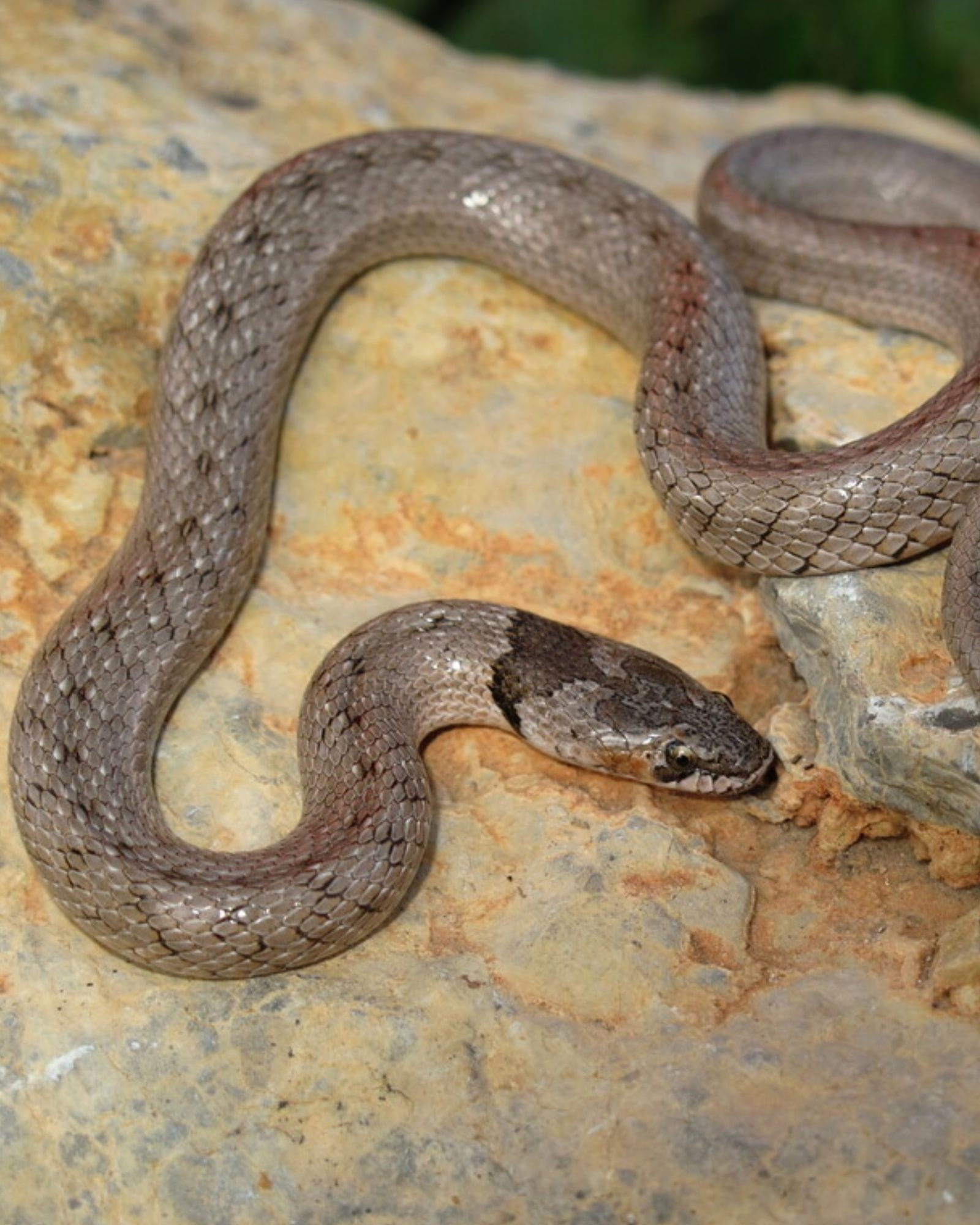
Abubaker's false smooth snake
Macroprotodon abubakeri Wade, 2001
FR · Couleuvre à capuchon d'Abubaker·حنش أبو بكر
Key field characters
Part of a difficult false smooth snake complex. The guide notes small dorsal spots that tend to align longitudinally, but morphology alone may not be sufficient and locality is important.
Habitat & natural history
A slow, ground-dwelling and fossorial snake using dry habitats with stones, scrub and loose soil. It is weakly venomous to its small reptile prey.
Distribution in Morocco
A Morocco-Algeria endemic known in Morocco only from the far north-east between Berkane and Saïdia.
Project assessment
Considered Data Deficient in the project guide because of its very restricted known range and limited information; habitat loss is the main identified pressure.
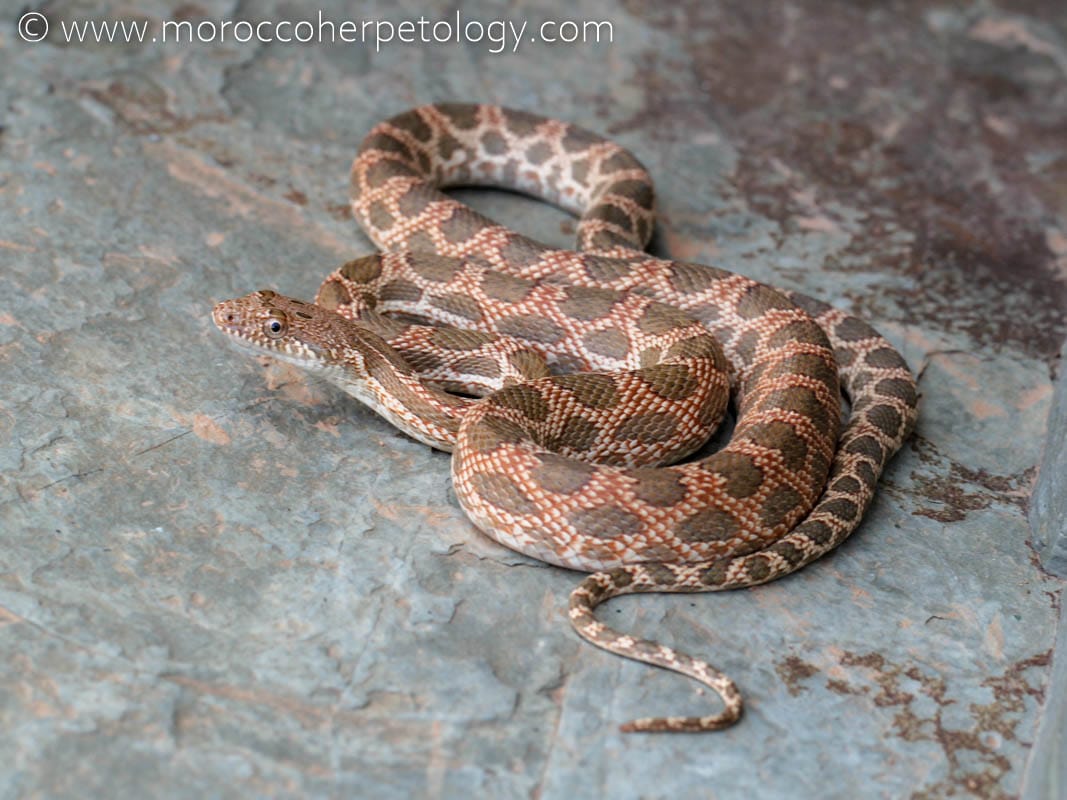
Maghreb diadem snake
Spalerosophis dolichospilus (Werner, 1923)
FR · Couleuvre à diadème du Maghreb·حنش التاج المغربي
Key field characters
A large, colourful snake with subdivided prefrontal scales, an orange iris, a pinkish or yellow ground colour and a row of large grey or greenish rounded blotches.
Habitat & natural history
Uses dry rocky steppe, often without trees, and hides by day in burrows, stone walls or below large rocks. It may bite defensively if restrained but is non-venomous.
Distribution in Morocco
A Maghreb endemic recorded through Morocco's arid and pre-Saharan belt from Tan-Tan toward the Moulouya and Figuig, including the upper Drâa and Ziz.
Project assessment
The guide treats it as Near Threatened nationally because of collection, snake-charming pressure and road mortality, particularly between Guelmim and Assa.
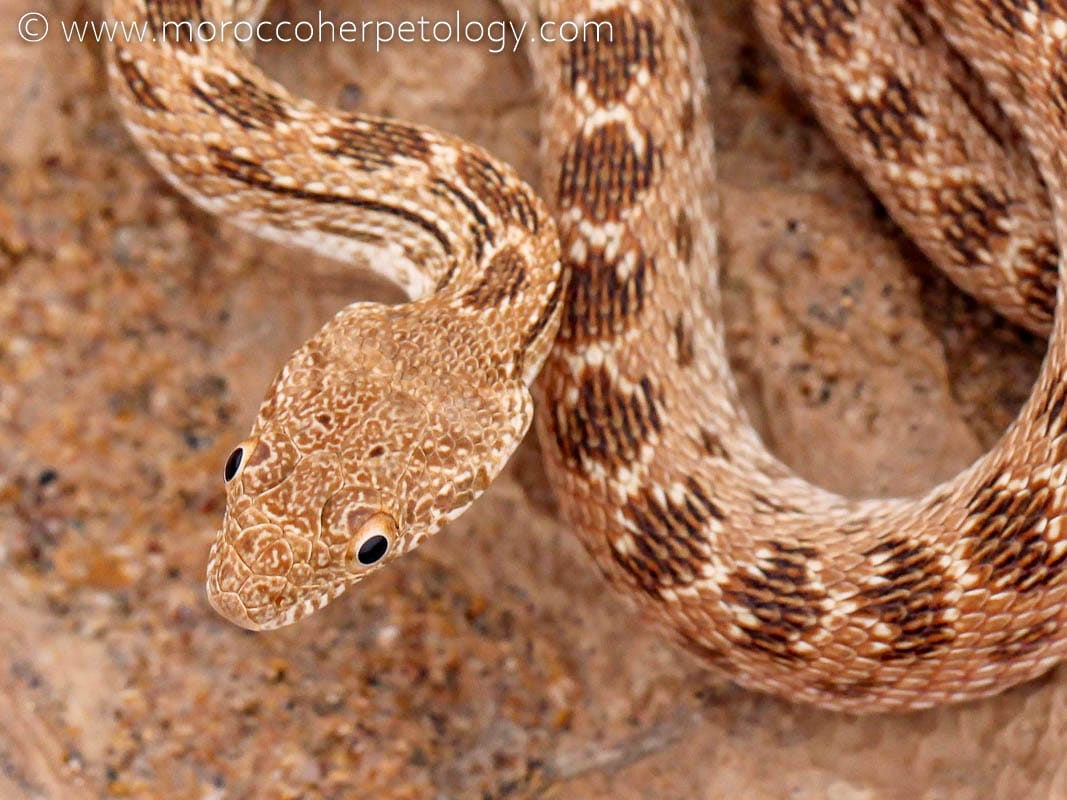
Diadem snake
Spalerosophis diadema (Schlegel, 1837)
FR · Couleuvre à diadème de Clifford·حنش كليفورد
Key field characters
A large desert snake with transversely stretched, weakly contrasted dorsal blotches. Each blotch is pale-edged mainly at its front and rear, not along the sides.
Habitat & natural history
Inhabits flat sandy and stony sectors of the Atlantic Sahara. It may defend itself by biting when captured but is not considered dangerous to humans.
Distribution in Morocco
Known from southern Morocco between Akhfennir and Laâyoune, with more recent records toward Dakhla and Aousserd.
Project assessment
Although treated as Least Concern in the guide, it remains rare and poorly studied nationally and is affected by road mortality and deliberate killing.
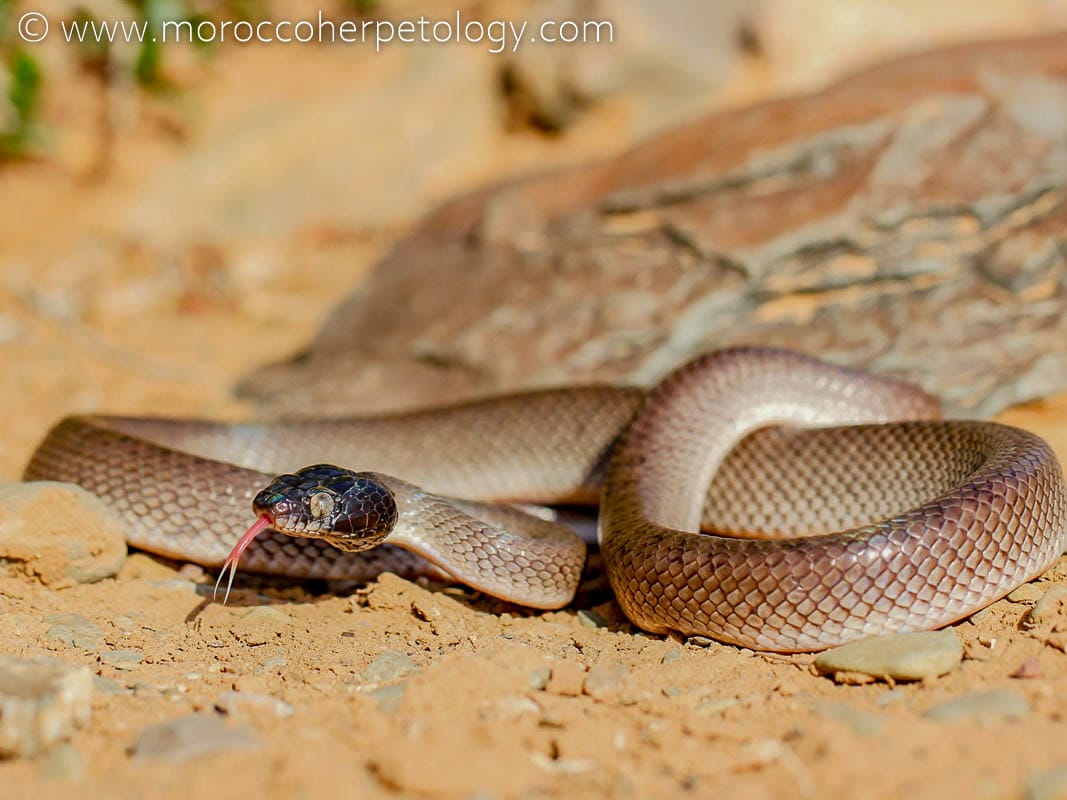
North African cat snake
Telescopus tripolitanus (Werner, 1909)
FR · Couleuvre-chat d'Afrique du Nord·حنش شبيه القط
Key field characters
A smooth, glossy snake with a black head, vertical cat-like pupils and a beige to reddish-brown body. Young snakes often show diffuse dark blotches.
Habitat & natural history
Occupies desert zones, oasis gardens, vegetated wadis and sites close to buildings. It hides beneath stones or in burrows during the day.
Distribution in Morocco
In Morocco, the species is scattered along Saharan margins, including the upper and lower Drâa, Errachidia, Figuig, Assa and Laâyoune, with isolated populations farther south.
Project assessment
The species is very rare and is listed as Data Deficient in the guide. More field surveys are needed to clarify its Moroccan range and population status.
Water and grass snakes
2 species
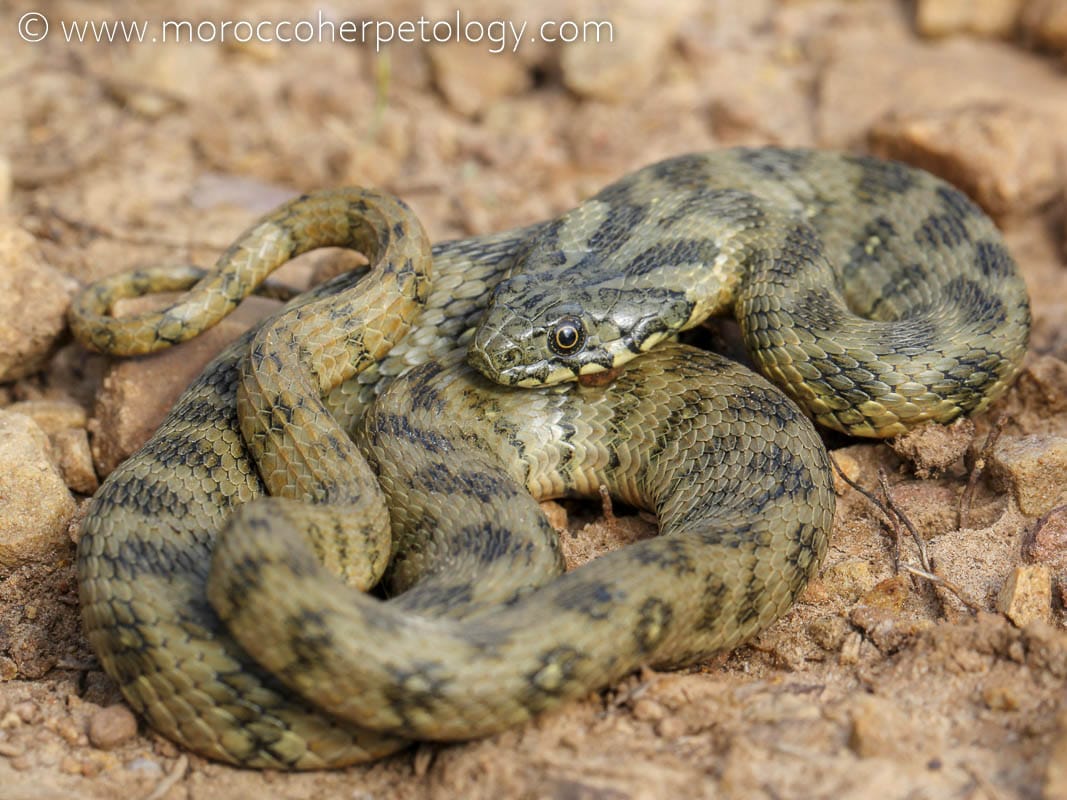
Viperine snake
Natrix maura (Linnaeus, 1758)
FR · Couleuvre vipérine·حنش الماء
Key field characters
An aquatic snake with keeled scales, round pupils and highly variable colour. Many individuals carry a dark dorsal zigzag; when threatened they flatten the head and hiss, mimicking a viper.
Habitat & natural history
Lives along freshwater margins and hunts in water. It is an excellent swimmer and may regurgitate prey to escape quickly. Despite its viper-like display, it is harmless.
Distribution in Morocco
Occurs in water bodies across most of Morocco, from coastal plains to about 2,600 m in the High Atlas and south through oases and wadis toward Assa and Figuig.
Project assessment
One of Morocco's most abundant snakes, but it is often killed after being misidentified as a viper. A zigzag pattern does not prove that a snake is venomous.
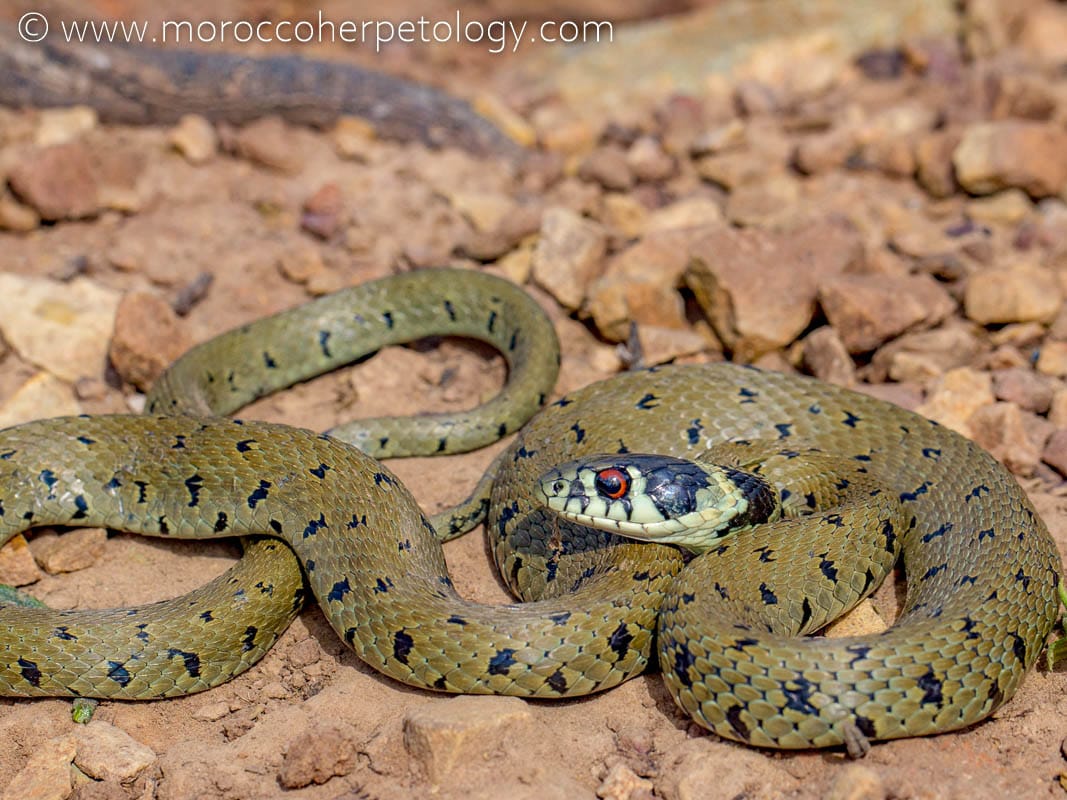
Iberian grass snake
Natrix astreptophora (Seoane, 1884)
FR · Couleuvre astreptophore·حنش مطوق
Key field characters
Natrix astreptophora Iberian grass snake Couleuvre astreptophore حنش مطوق Natricidae Non-venomous Rare and localized in Morocco A medium-sized water-associated snake with a vivid reddish iris and small black marks on the flanks and back. Juveniles have a pale collar bordered by two black neck patches; this collar fades with age.
Habitat & natural history
Prefers humid habitats rich in frogs and toads and often coexists with Natrix maura. It swims well but tends to dive less frequently.
Distribution in Morocco
In Morocco, the species is rare and localised in the Rif and Middle Atlas, with a record from Sidi Boughaba. Historical presence north of the High Atlas is uncertain.
Project assessment
Its Moroccan status is difficult to assess. Wetland loss, water-body drainage, drought and climate change are highlighted as major concerns.
African house snakes
1 species
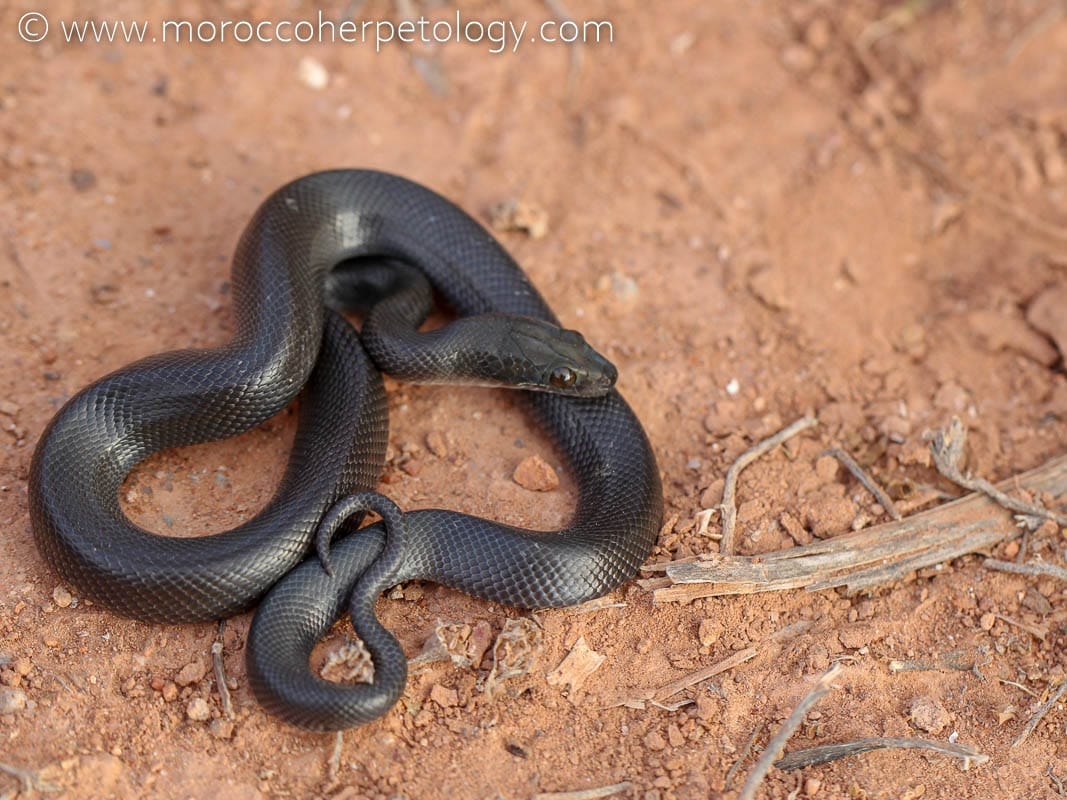
African house snake
Boaedon fuliginosus (Boie, 1827)
FR · Couleuvre commune d'Afrique·حنش إفريقي
Key field characters
A smooth-scaled snake with a plain, glossy body and vertical pupils. Juveniles may be jet black, becoming coffee-brown or olive-green with age; the belly is pale.
Habitat & natural history
In Morocco it occupies arid coastal steppe influenced by Atlantic humidity and relatively mild temperatures. It kills prey by constriction.
Distribution in Morocco
A rare Afro-tropical relict localized in south-western Morocco, particularly the Atlantic belt around Sidi Ifni and Tan-Tan, within a broader range described from Taliouine toward Laâyoune.
Project assessment
The guide treats it as Vulnerable in Morocco because of its rarity, deliberate killing and collection for snake-charming activities.
Sand racers
4 species
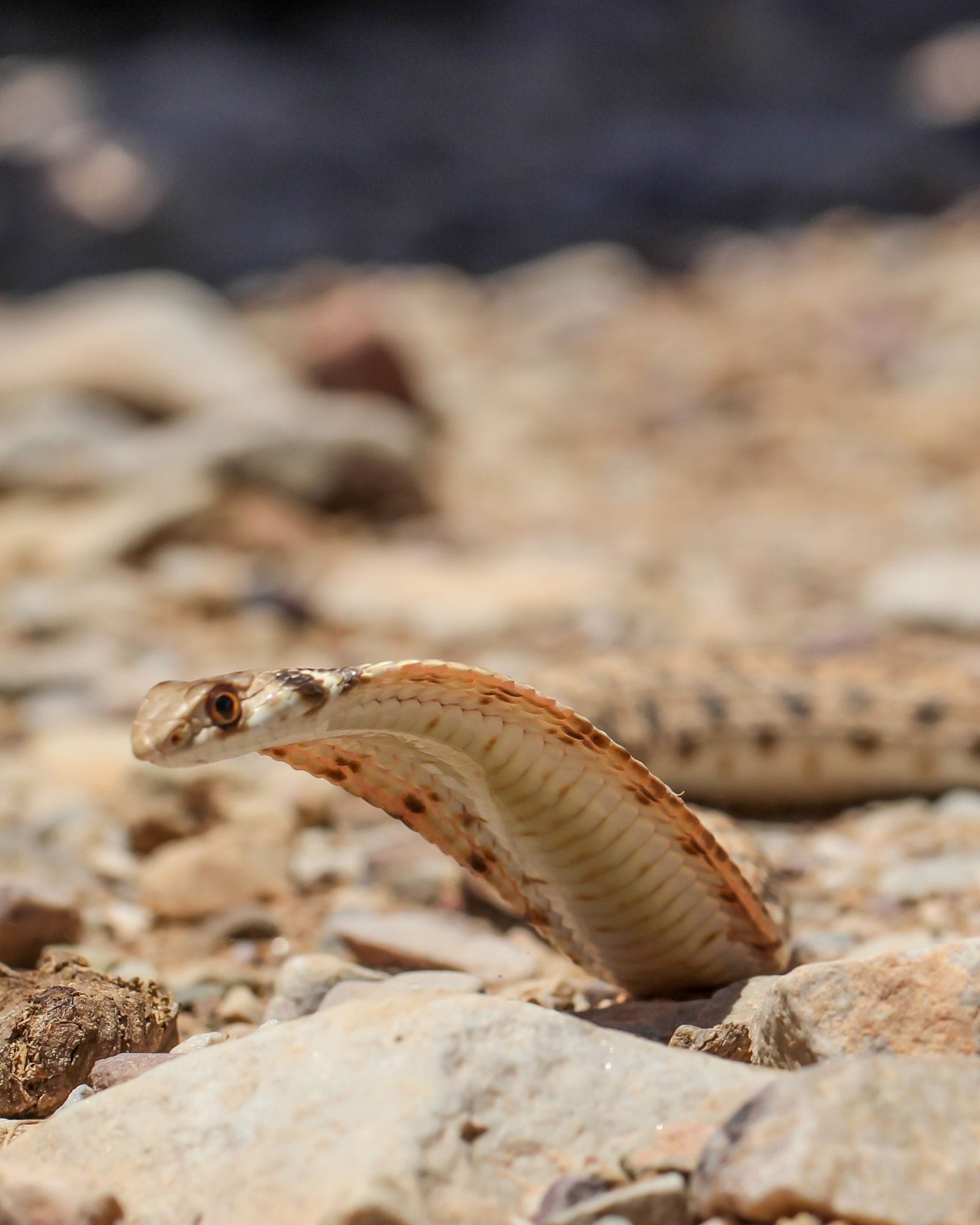
Moila snake
Rhagerhis moilensis (Reuss, 1834)
FR · Couleuvre de Moïla· العريض
Key field characters
A slender desert snake with large orange-irised eyes and two dark oblique bars behind the head. When threatened it may flatten the neck into a cobra-like hood.
Habitat & natural history
Uses stony desert, sparse scrub and dry wadis, sometimes near settlements. It is rear-fanged; the guide reports no known human envenomation cases.
Distribution in Morocco
A Saharan species occurring broadly from Figuig across Morocco's desert regions.
Project assessment
The species is listed as Least Concern in the guide but frequently killed on roads when using warm asphalt or moving between feeding and breeding areas.
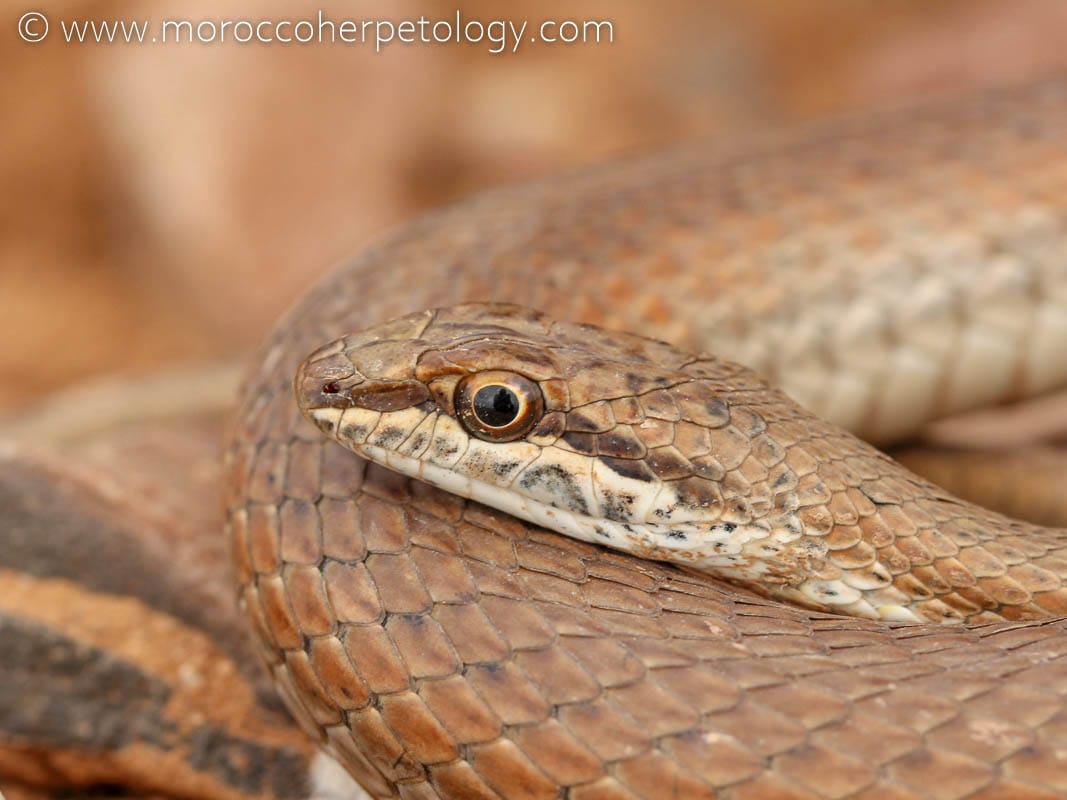
Schokari sand racer
Psammophis schokari (Forsskål, 1775)
FR · Couleuvre de Schokar·حنش شقاري
Key field characters
A very slender racer with a long narrow head, large round-pupilled eyes and smooth matte scales. Moroccan snakes may be strongly striped, weakly striped or almost plain.
Habitat & natural history
Uses arid steppe, oases, wadis, sandy desert and farmland edges. It actively searches for prey and uses weak venom delivered by rear fangs.
Distribution in Morocco
Occupies most of Morocco outside the wettest north-western tip, from Saharan lowlands to high elevations in the High Atlas.
Project assessment
The species remains one of the country's commonest snakes, although local densities may decline sharply in densely settled landscapes.
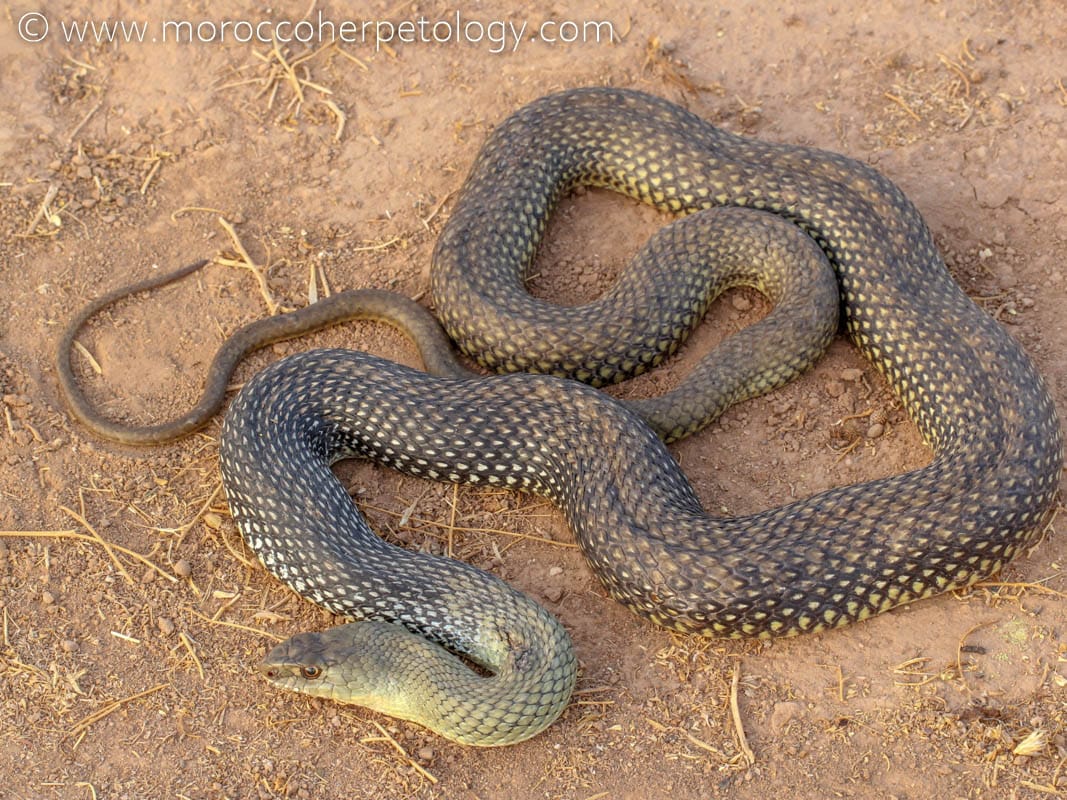
Western Montpellier snake
Malpolon monspessulanus (Hermann, 1804)
FR · Couleuvre de Montpellier·حنش مونبلان
Key field characters
A large, robust racer with round pupils, a pronounced brow scale and matte, grooved dorsal scales. Adult males often become olive with a dark saddle behind the neck; females retain a mottled pattern.
Habitat & natural history
Lives in sunny scrub, rocky slopes, open woodland, farmland and settlement edges. It hunts with the head raised and can climb shrubs and trees.
Distribution in Morocco
One of Morocco's most widespread snakes, present through most of the country to the Drâa oases and the Atlantic Saharan coast.
Project assessment
The species is listed as Least Concern in the guide but heavily affected by road mortality, deliberate killing and collection. Large individuals can potentially envenomate when restrained.
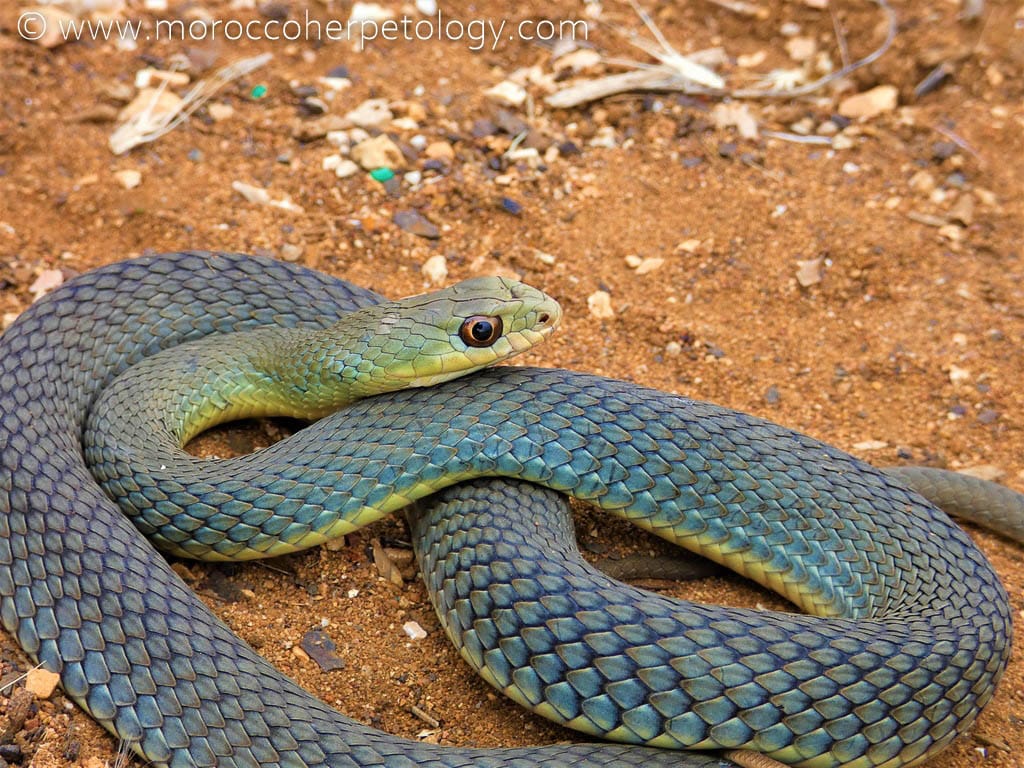
Eastern Montpellier snake
Malpolon insignitus (Geoffroy Saint-Hilaire, 1827)
FR · Couleuvre de Montpellier orientale·حنش مونبلان الشرقي
Key field characters
Very similar to the western Montpellier snake but generally smaller and lacking the dark neck saddle typical of old M. monspessulanus males. Intermediate-looking individuals can complicate identification.
Habitat & natural history
Uses sunny open terrain, dry scrub and rocky agricultural landscapes. It is a rear-fanged predator and should never be handled.
Distribution in Morocco
In Morocco, the species is restricted to the east, especially the high plateaus from east of the Ziz valley toward the south of Oujda, connected to Algerian populations.
Project assessment
The species is listed as Data Deficient in the guide because of its restricted Moroccan range and limited ecological information.
Cobras
1 species
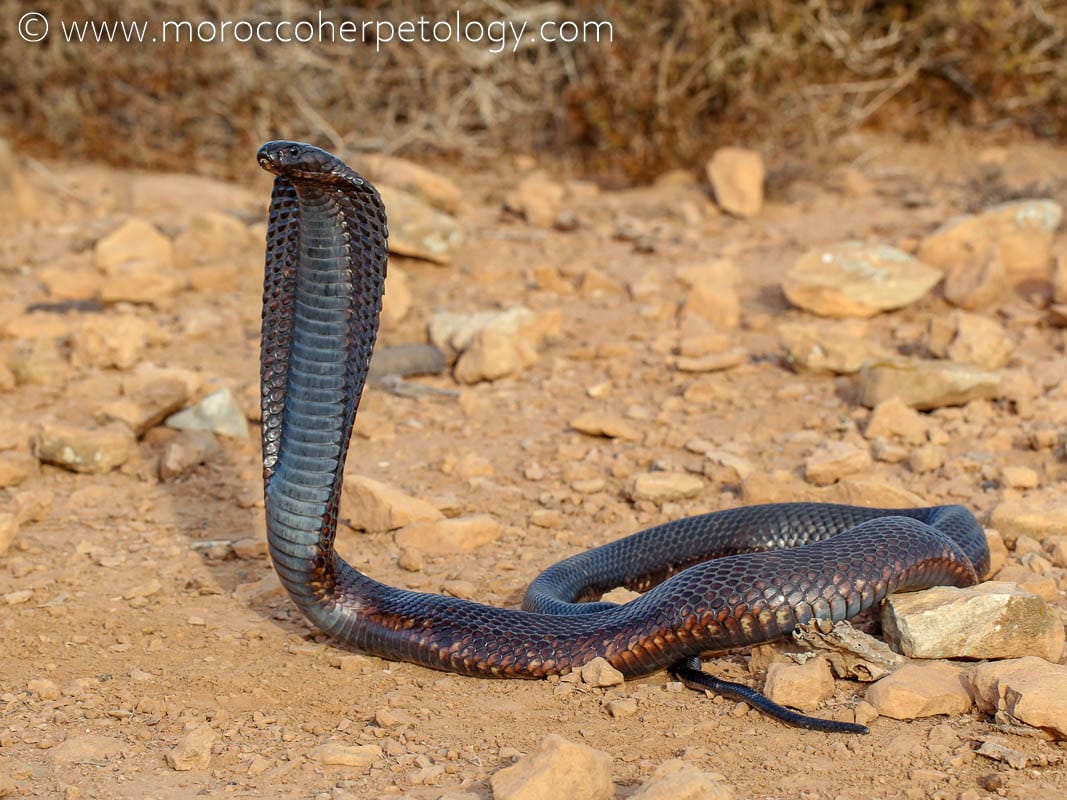
Egyptian cobra / Moroccan black cobra
Naja haje (Linnaeus, 1758)
FR · Cobra noir du Maroc·الكوبرا المغربية
Key field characters
A large smooth-scaled cobra. Adults are often glossy black with variable yellow on the head or underside; juveniles may have a black head and hood contrasting with a pale body.
Habitat & natural history
Uses rocky arid scrub, coastal steppe, oases, vegetated wadis and ruins. It usually flees but raises the forebody and spreads a hood when cornered.
Distribution in Morocco
Mainly recorded along the Atlantic belt from Essaouira toward Tarfaya, with isolated inland populations around Ouarzazate and eastward toward Figuig.
Project assessment
The Moroccan population is considered Vulnerable in the guide, mainly because of intensive collection for snake charming and deliberate killing. Never approach or provoke a cobra.
Vipers
6 species
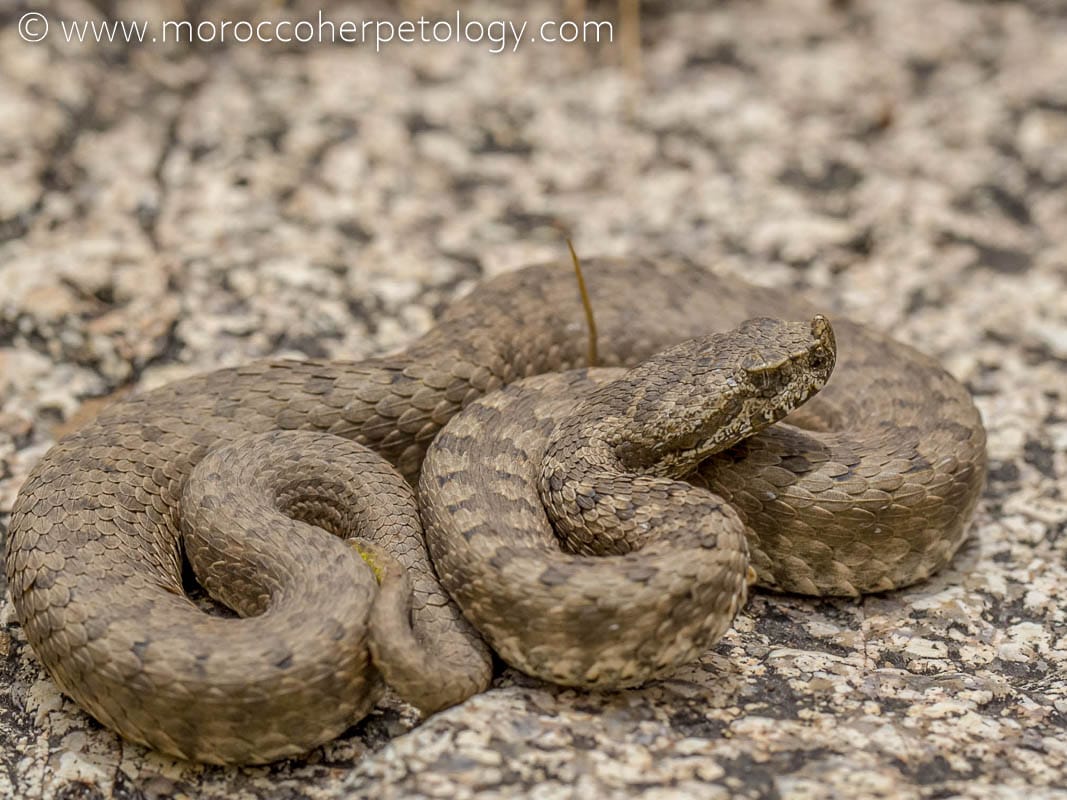
Dwarf Atlas mountain viper
Vipera monticola Saint-Girons, 1953
FR · Vipère de l'Atlas· أفعى الأطلس
Key field characters
A small viper with a triangular head, strongly upturned snout and a dark dorsal zigzag. The high-Atlas monticola form is smaller and generally duller than northern populations.
Habitat & natural history
The northern form occupies sunny scree, scrub and open forest in the Rif and Middle Atlas. The monticola form occurs above about 2,400 m on exposed High Atlas slopes with cushion plants.
Distribution in Morocco
Localized in the Rif and Middle Atlas, with the monticola form restricted to High Atlas massifs including Toubkal, Tichka, Siroua and M'Goun.
Project assessment
Very rare, with small populations sensitive to habitat change, collecting and climate change. Identification should never be attempted by close approach.
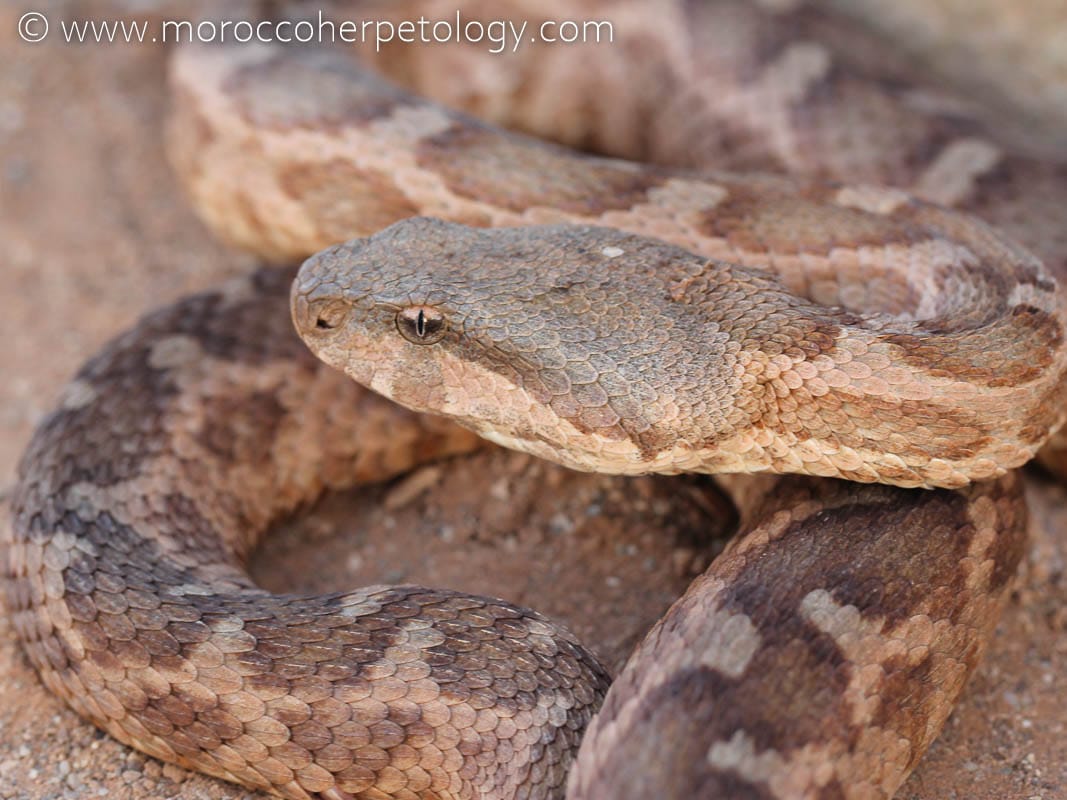
Moorish viper
Daboia mauritanica (Gray, 1849)
FR · Vipère de Maurétanie·أفعى موريطانية أو مورية
Key field characters
Morocco's largest viper, with a broad triangular head covered in small keeled scales, vertical pupils and a heavy body carrying a broad wavy or zigzag dorsal band. Colour is highly variable.
Habitat & natural history
Uses exposed, relatively dry rocky or densely shrubby sites, including mountain slopes, argan woodland and thorn scrub. It may bask on cool mornings.
Distribution in Morocco
Widespread in Mediterranean Morocco and also recorded around Figuig and Ouarzazate, with southern extensions toward Assa and Tan-Tan.
Project assessment
Frequently killed when encountered and also collected for snake charming. It is often confused with harmless patterned snakes, especially Hemorrhois hippocrepis.
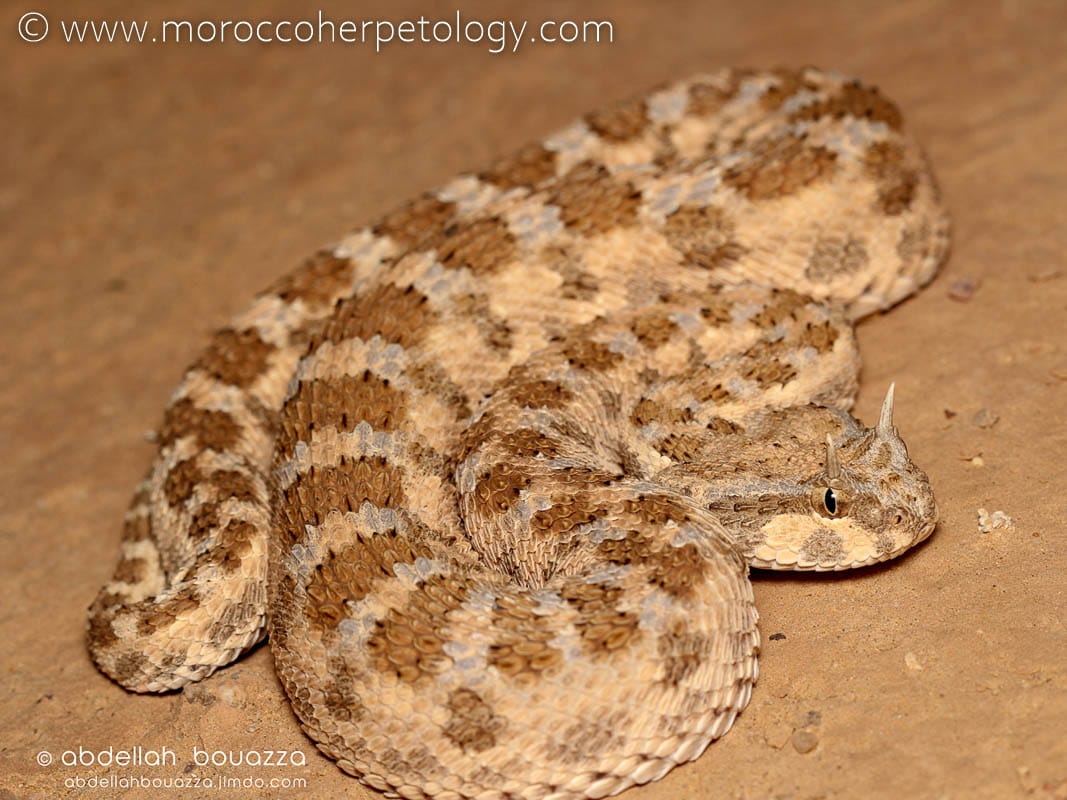
Desert horned viper
Cerastes cerastes (Linnaeus, 1758)
FR · Vipère à cornes·أفعى قرناء
Key field characters
A medium-sized, heavily keeled viper often bearing one horn-like scale above each eye. Hornless individuals occur, so horns alone are not a complete identification criterion.
Habitat & natural history
Occupies partly sandy desert, stony plains, acacia savanna, oasis margins and low cliffs. It sidewinds and may hide in sand, burrows or beneath rocks.
Distribution in Morocco
Occurs south of the Atlas through pre-desert Morocco and widely across the Moroccan Sahara, becoming less frequent near parts of the Atlantic coast.
Project assessment
The species remains widely distributed but is affected by road mortality and deliberate killing. It warns by hissing and rubbing serrated flank scales when disturbed.
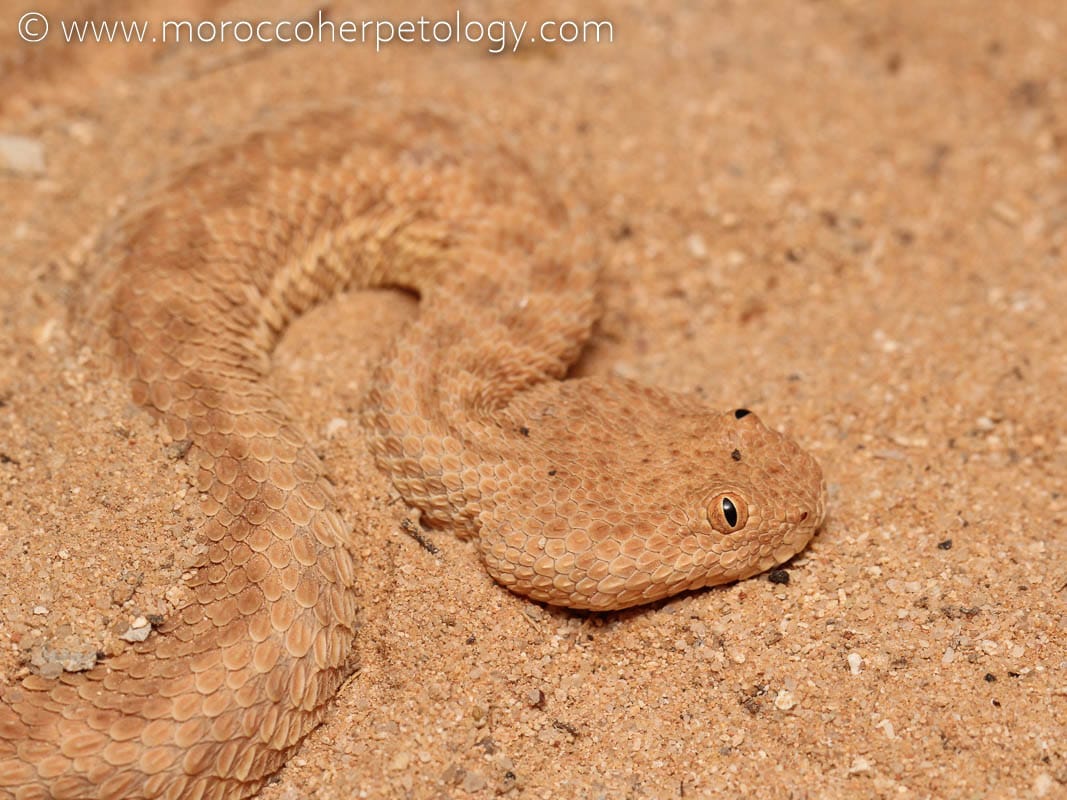
Sahara sand viper
Cerastes vipera (Linnaeus, 1758)
FR · Vipère de l'erg·أفعى الرمال / أفعى قرعاء
Key field characters
Cerastes vipera Sahara sand viper Vipère de l'erg أفعى الرمال / أفعى قرعاء Viperidae Medically important Rare and habitat-specialized A small sand viper with upward-facing eyes and no horns. Coastal Atlantic populations can be darker and more strongly patterned than snakes from inland ergs.
Habitat & natural history
Strictly associated with wind-blown dunes. It buries itself by lateral movements until only the eyes remain visible and travels by sidewinding at night.
Distribution in Morocco
Known from the large south-eastern ergs around Merzouga and M'hamid and from sandy Atlantic Sahara habitats between Tan-Tan and southern Dakhla, extending inland toward Smara and Aousserd.
Project assessment
Rare, but many sites are buffered from direct disturbance by their difficult access. Dune alteration and vehicle traffic remain relevant local concerns.
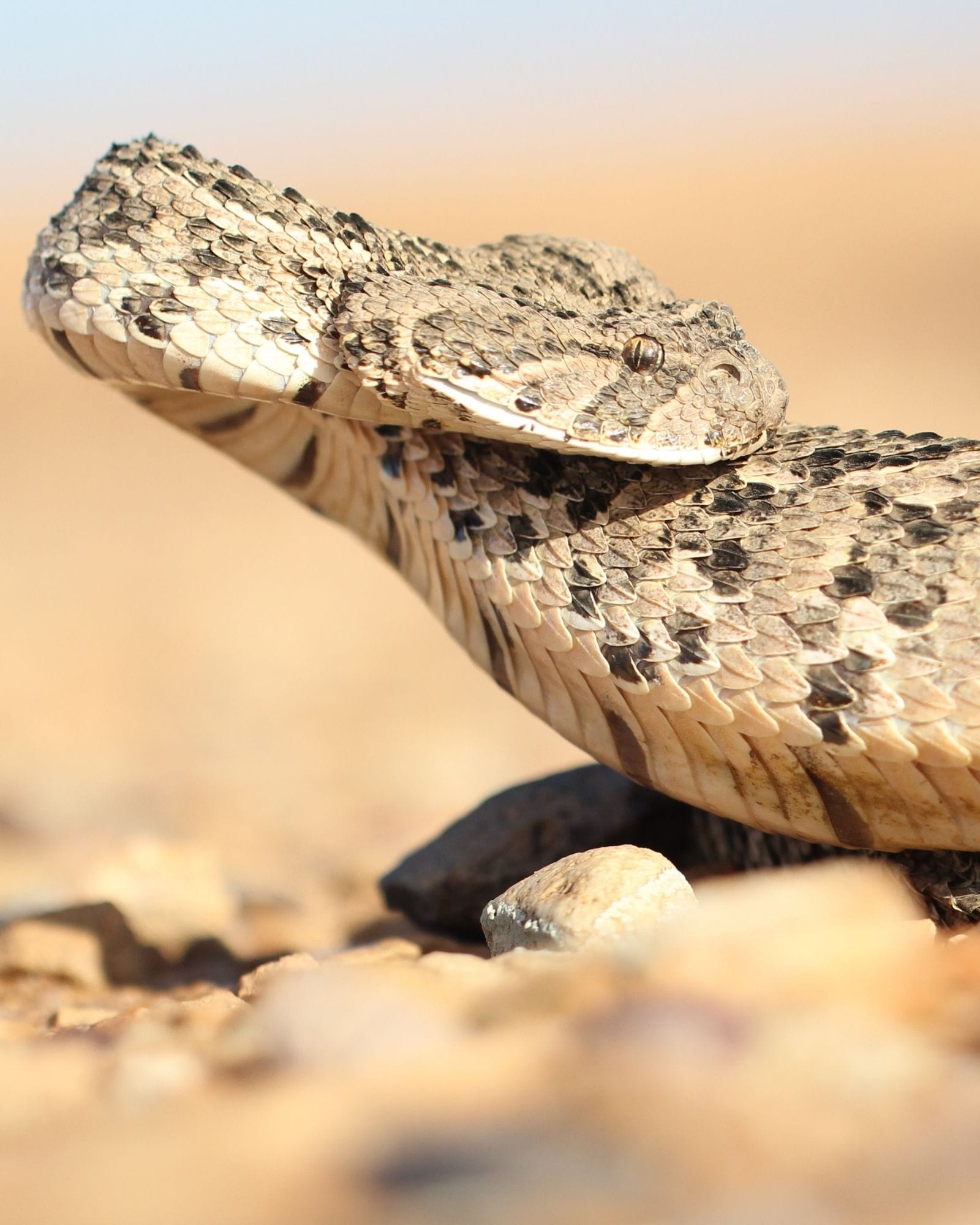 © Bouazza A.
Puff adder
Bitis arietans (Merrem, 1820)
FR · Vipère heurtante·أفعى نفاثة أو الهيشة
Key field characters
A very thick-bodied viper with a broad flattened head, small strongly keeled head scales, small vertical-pupilled eyes and narrow pale-edged curved bands across a beige or grey body.
Habitat & natural history
A secretive ambush predator of coastal steppe influenced by Atlantic humidity. It moves mostly at night and gives a loud warning hiss when threatened.
Distribution in Morocco
In Morocco, the species is restricted to the south-west along the Atlantic Sahara from the Souss region toward northern Dakhla, with important records around Sidi Ifni, Guelmim, Tan-Tan, Laâyoune and Boujdour.
Project assessment
Severely affected by road mortality, collection and habitat pressure. The project notes possible disappearance from parts of its former Souss range.
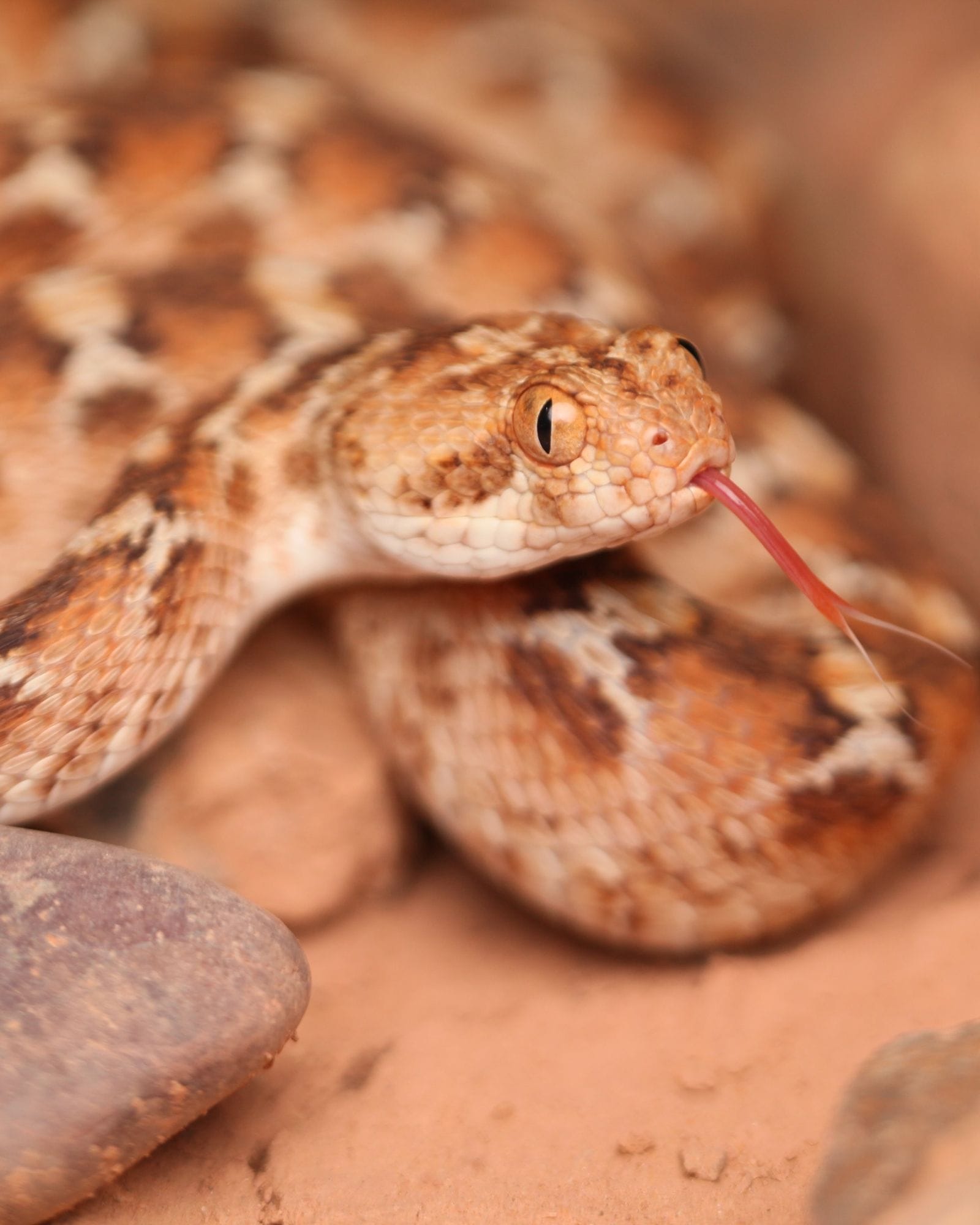
White-bellied carpet viper
Echis leucogaster Roman, 1972
FR · Échide à ventre blanc·أفعى الأهرام
Key field characters
A medium-sized viper with a distinct head, vertical pupils, a pale belly and oblique flank scales bearing serrated keels. When alarmed it rubs the flanks to make a loud rasping sound.
Habitat & natural history
Associated with rocky subdesert and thorny acacia landscapes, sometimes visiting oases or isolated buildings in search of prey and moisture.
Distribution in Morocco
One of Morocco's rarest snakes, recorded from the Assa area, Zemmour, Agdz, Tata and Bir Anzarane north-east of Dakhla.
Project assessment
Very poorly known nationally. Targeted surveys and strict avoidance of collection or killing are essential for improving its conservation assessment.
No species match the selected filters.
Why Morocco's snakes require protection
An important role in regulating prey populations and maintaining food-web function is performed by snakes. Despite this ecological role, many species remain exposed to direct persecution and rapid habitat transformation.
Loss and fragmentation
Reductions in shelter availability, reproductive sites, and prey resources may be caused by urban expansion, intensive agriculture, wetland alteration, and the degradation of steppe and scrub habitats.
Road mortality
Substantial road mortality is documented when snakes cross roads or use asphalt surfaces that remain warm at night, particularly in Saharan and pre-Saharan landscapes.
Fear and misidentification
Harmless species are regularly killed because of their resemblance to vipers. A dorsal zigzag, dark head, or defensive posture should not be interpreted as evidence of danger.
Snake charming and trade
Cobras, Montpellier snakes, diadem snakes, and vipers are collected for exhibition or trade, potentially increasing pressure on already localised populations.
Contributing to the documentation of Morocco's snakes
Observation records can improve knowledge of distribution and conservation. Animals should be photographed without handling, and the image, locality, and date can then be submitted to Morocco Herpetology.
Editorial note
Species accounts are adapted from the Morocco Herpetology project guide Snakes of Morocco (2019) and from the site's current framework, which recognises 26 species distributed among eight families. Where applicable, national conservation status is explicitly presented as an assessment derived from the project guide.
First-aid recommendations follow current World Health Organization guidance. Taxonomy, distribution, and conservation assessments should be reviewed whenever the Morocco Herpetology database is updated.