Turtles of Morocco
From dry Mediterranean landscapes to rivers, wetlands and open sea, Morocco's turtles occupy three very different worlds. Discover tortoises, freshwater turtles and marine turtles through habitat, identification and ecology.
All tortoises and terrapins are turtles
Turtle is the broad term. Here, tortoise describes the predominantly terrestrial form, freshwater turtle / terrapin describes species associated with inland waters, and sea turtle describes highly specialised marine forms.
They share the same remarkable body plan — a shell integrated with the skeleton — but their limbs, shell shape, movement and ecology reveal different adaptations to land, freshwater and sea.
Where do Morocco's turtles live?
Habitat is the easiest way to understand the major turtle groups before learning scientific names.
Tortoises
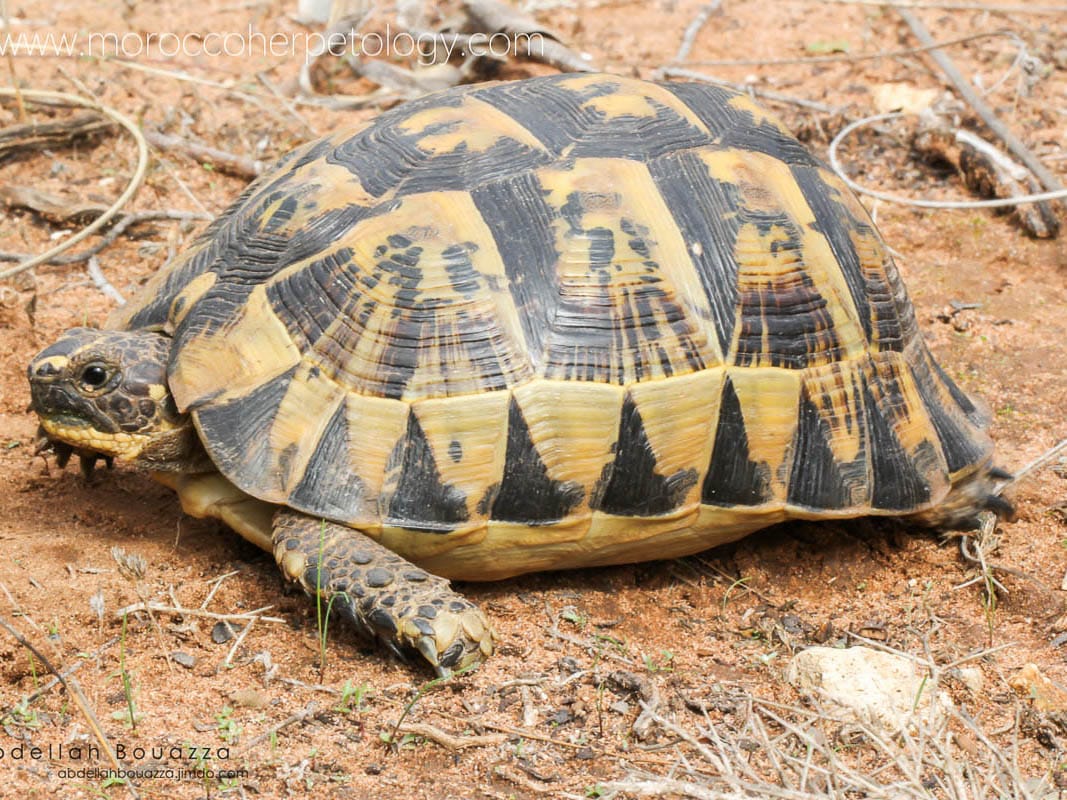
Built for walking rather than swimming. A robust, domed shell and strong limbs suit dry ground, scrub and Mediterranean landscapes.
Explore land turtles →Terrapins & freshwater turtles
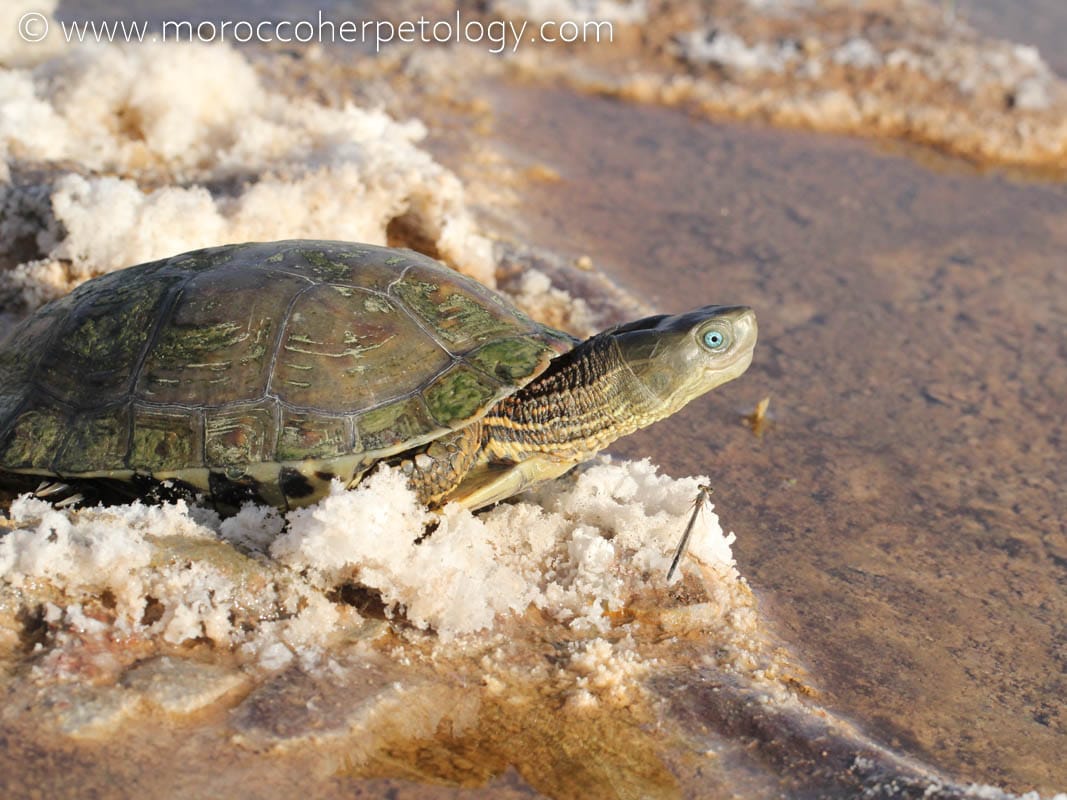
Closely tied to rivers, ponds, marshes and other inland waters. Their flatter shells and aquatic behaviour distinguish them from tortoises.
Explore freshwater turtles →Marine turtles
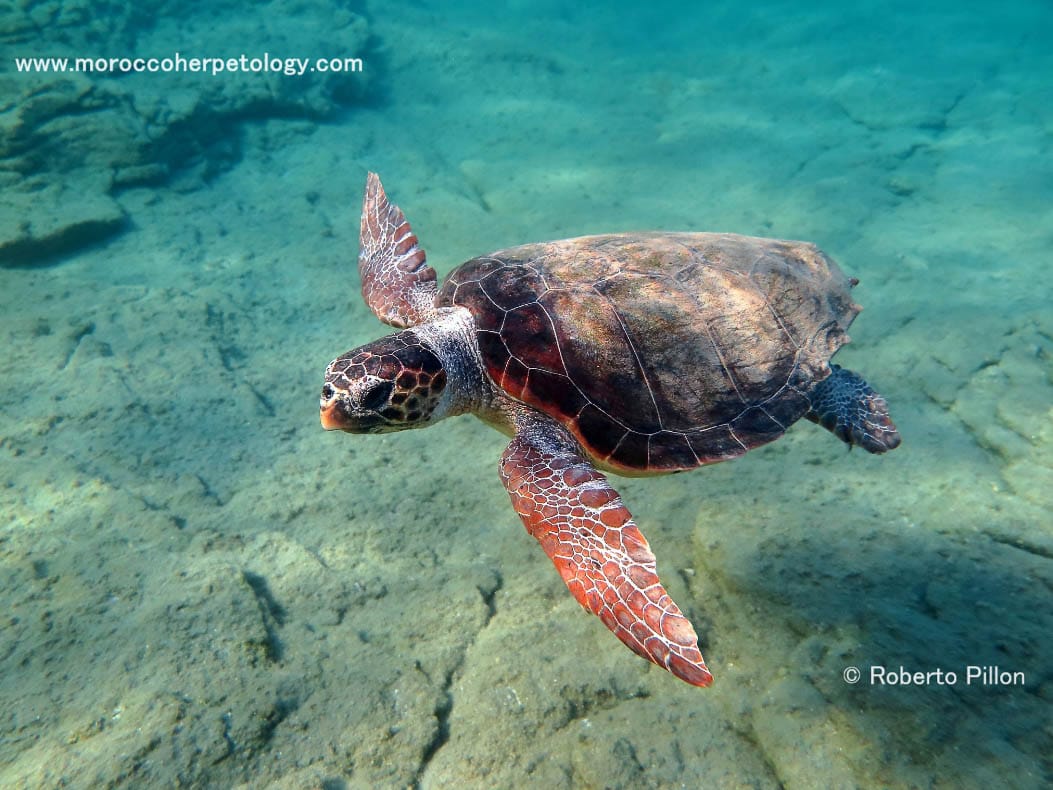
Ocean travellers with streamlined shells and powerful flippers, connecting distant Atlantic and Mediterranean habitats.
Explore sea turtles →How can you tell them apart?
Look at the limbs
Strong walking legs suggest a tortoise; webbed feet suggest a freshwater turtle; long flippers indicate a marine turtle.
Look at the shell
Terrestrial shells tend to be more domed, while aquatic species usually have a lower, more streamlined profile.
Look at the habitat
Habitat is a useful clue, but not proof by itself: turtles can move between nearby habitats or be displaced.
Meet Morocco's turtles
Every species is presented using the same reading frame so visitors can compare habitat, ecology, Moroccan distribution and taxonomy at a glance.
Terrestrial tortoise
A turtle adapted primarily to terrestrial habitats.
Greek / Spur-thighed Tortoise
Testudo graecaTerrestrial Mediterranean specialist
A mainly terrestrial tortoise associated with open scrub, steppe, agricultural mosaics and other dry to Mediterranean landscapes. Activity is strongly seasonal and feeding is dominated by herbaceous vegetation.
Broad Moroccan range
In Morocco, Testudo graeca occurs from the Anti-Atlas region (Tiznit–Sidi Ifni) north to the Tingitana Peninsula, across much of the Atlantic plain, and along the Mediterranean zone from the eastern Rif toward the Algerian border.
Order Testudines · Family Testudinidae
Moroccan populations have been treated under several subspecific names. The Morocco Herpetology treatment used here includes T. g. graeca, T. g. marokkensis and T. g. whitei; subspecific limits have varied among taxonomic treatments.
Morocco's inland-water turtles
Species associated with rivers, ponds, wetlands and other inland waters.
Mediterranean Pond Turtle
Mauremys leprosaA flexible freshwater turtle
Uses rivers, streams, ponds, marshes and other freshwater habitats. It regularly basks near the water and is an opportunistic feeder, taking both animal and plant material.
Widespread in suitable Moroccan waters
Mauremys leprosa is broadly distributed in Morocco wherever suitable inland waters persist. The form M. l. saharica is especially associated with southern Morocco and more arid freshwater systems.
Order Testudines · Family Geoemydidae
Two widely recognised subspecies are Mauremys leprosa leprosa and Mauremys leprosa saharica. Morocco is especially important to the geographic variation described within this species complex.
European Pond Turtle
Emys orbicularisVegetated freshwater habitats
In Morocco it is associated mainly with small ponds, streams and other freshwater habitats with aquatic or riparian vegetation. Basking is an important part of its daily activity.
A restricted Moroccan distribution
Moroccan populations are highly fragmented and occur mainly in the western Rif and Middle Atlas, with scattered records from the Gharb plain and eastern Rif. Precise modern records are therefore particularly valuable.
Order Testudines · Family Emydidae
Moroccan populations are assigned to Emys orbicularis occidentalis, the western North African–Iberian form of the widespread European pond turtle.
Sea turtles recorded in Moroccan waters
Highly mobile species linking Morocco with wider Atlantic and Mediterranean ecosystems.
Loggerhead Turtle
Caretta carettaOceanic juveniles, coastal foragers
Young loggerheads spend years in open-ocean habitats before shifting increasingly to coastal foraging grounds. Their powerful jaws allow them to feed on crabs, molluscs and other hard-bodied marine prey.
Regular visitor to Moroccan waters
Loggerheads regularly occur along Morocco's Atlantic coast and also use the Mediterranean. Moroccan records form part of much larger regional migrations between feeding and breeding areas.
Order Testudines · Family Cheloniidae
Caretta caretta is the only living species of the genus Caretta. It belongs to the hard-shelled sea turtle family Cheloniidae.
Green Turtle
Chelonia mydasFrom open ocean to shallow coasts
Juveniles begin life in oceanic habitats and later recruit to shallow coastal feeding areas. Adults are unusual among sea turtles in being predominantly herbivorous, feeding mainly on seagrasses and algae.
Regular but less frequently observed
Green turtles visit Moroccan waters as part of wider Atlantic and Mediterranean movements. Along Morocco's Atlantic coast they are recorded less frequently than loggerheads and leatherbacks.
Order Testudines · Family Cheloniidae
Chelonia mydas is the sole living species of the genus Chelonia and one of the hard-shelled marine turtles of the family Cheloniidae.
Leatherback Turtle
Dermochelys coriaceaA deep-diving ocean specialist
The leatherback is the largest living turtle and lacks the hard scuted shell of other sea turtles. It is highly migratory, capable of deep dives, and feeds heavily on jellyfish and other soft-bodied pelagic prey.
Regular Atlantic visitor
Leatherbacks regularly visit Moroccan Atlantic waters as part of broad oceanic migrations. Long-term Moroccan stranding records show it as one of the country's more frequently encountered sea turtles after the loggerhead.
Order Testudines · Family Dermochelyidae
Dermochelys coriacea is the only living species of both the genus Dermochelys and the family Dermochelyidae, making it evolutionarily distinct from the hard-shelled marine turtles.
Hawksbill Turtle
Eretmochelys imbricataA specialised coastal feeder
Hawksbills are strongly associated with warm coastal habitats, especially reefs and structurally complex environments. Their narrow beak is well suited to extracting prey from crevices; sponges form a major part of the diet.
An occasional Moroccan visitor
The hawksbill is mainly tropical and subtropical. In Morocco it is considered an occasional marine visitor rather than a regularly encountered species.
Order Testudines · Family Cheloniidae
Eretmochelys imbricata is the sole living member of the genus Eretmochelys. Modern treatments generally recognise it as a single species without formal subspecies.
Olive Ridley Turtle
Lepidochelys olivaceaA small, wide-ranging sea turtle
Olive ridleys use both oceanic and coastal waters and feed opportunistically on crustaceans, molluscs, jellyfish and other marine organisms. In major nesting regions, the species is famous for synchronized mass nesting events.
An occasional Atlantic visitor
Lepidochelys olivacea occurs mainly in tropical and subtropical oceans. It is recorded only occasionally in Moroccan waters, where observations are especially valuable because encounters are comparatively uncommon.
Order Testudines · Family Cheloniidae
The olive ridley belongs to the genus Lepidochelys, together with Kemp's ridley L. kempii. No subspecies are generally recognised.
Why turtle observations matter
The challenges differ on land, in freshwater and at sea, but good field observations can help document where turtles occur and how their habitats change.
Habitat change & collection
Photograph wild tortoises where you find them and avoid moving or collecting animals unnecessarily.
Wetland & river condition
Water availability, pollution, channel modification and habitat connectivity can influence freshwater turtle populations.
Fisheries & marine pressures
Entanglement, accidental capture, marine debris and coastal pressures can affect turtles moving through marine habitats.
Have you seen a turtle in Morocco?
A photograph, date and precise location can turn a simple encounter into a useful biodiversity record. Pin the observation on the map and share the original photo or video with Morocco Herpetology.